Friday, April 23, 2010

Florida: the Dry Tortugas

Arguably our Dry Tortugas day trip was everyones' favorite. Wikipedia offers a thorough write-up on the Dry Tortugas and Fort Jefferson which I have linked here. There is something for visitors of many interests; history buffs, lighthouse counters, campers, snorklers and, of course, birders.

We took a 2-1/2 boat ride on the Atlantic Jefferson leaving Key West at 8:00 am and arrived at 10:30 am. On the way out the water became quite rough and choppy. While the boat was very stable overall, depending on the roughness of the water, especially upon reaching the open channel, there is definitely the possibility to become seasick.

We sat in the open bow and scanned the water for seabirds. We saw a couple of pods of dolphins surface briefly. Our first bird was a brown bird with long, pointed wings and a pointed body at both the head and the tail with white underside - Brown Booby (Sula leucogaster). Further out, our first terns flew by - Roseate Terns (Sterna dougallii).


The wind picked up and the water became rougher. I looked to my left and saw three songbirds battling by just off the portside. Seeing them made my stomach sink. They were so near, yet still so far. In open water we began to scan for Audubon's Shearwater (Puffinus lherminieri). We saw one - no, wait, it was a Common Nighthawk (Chordeiles minor) flying low by the starboard side, its bouncing flight just above the water.

The water became rougher and the crew closed off the bow of the boat. In the cabin I was distracted by a couple of children who were seasick. Since I was queasy myself I quickly did my best to return my attention to the horizon. A large white and black bird flew by. I could see Bill and the other birders still outside with their bins up - Masked Booby (Sula dactylatra). I decided that it was better outside and rejoined the hardcore birders on the portside bench.

Finally, we neared the island. Sooty Terns (Onychoprion fuscatus), Brown and Masked boobies, Maginificent Frigatebirds (Fregata magnificens), Brown Noddies (Anous stolidus) were now easily seen. As the boat approached the dock, we could see old wharf pylons each with a bird or two. Most were sleeping. Black-bellied Plovers (Pluvialis squatarola) seemed to occupy most of the pylons, but a few Whimbrels (Numenius phaeopus) and gulls also rested here.


Fort Jefferson is an interesting place. I'm not a war history buff, but apparently as the fort was being built with turrets for canons, technology changed for that kind of weaponry and the fort was obsolete before it could even be completed. From then on, at least one of the things it was used for was as a prison. In the photo above, just to the left of the Fort Jefferson sign, you can see a gangplank over the moat leading through an entry. Walking though this leads you to a large open space as in the photo below.


Would it be a cliche to write bird life exploded before our eyes? Yes, it would, but that's what happened. Cattle Egrets (Bubulcus ibis) clustered together at one end, swallows swooped over the grass, Merlins (Falco columbarius) perched high on leafless limbs of scattered trees, a Peregrine (Falco peregrinus) occupied a high perch on the fort's antenna, warblers flew low from one bush to another, several nighthawks were flying. Magnificent Frigatebirds soared overhead. Green Herons (Butorides virescens) flew across the open space. We were in a place that gives new meaning to the words migrant trap.

American Redstart (Setophaga ruticilla)

For four hours we birded the whole inside and outside of the fort to find every bird. Even then we missed some. The island is small and easy to bird, but we all would have enjoyed another hour or two. The birds in the photos below represent just a smattering of what we saw and what I was able to photograph.

Prairie Warbler (Dendroica discolor)

Hooded Warbler (Wilsonia citrina)

Black-throated Blue Warbler (Dendroica caerulescens)

Ovenbird (Seiurus aurocapilla)

Cape May Warbler (Dendroica tigrina)

Dreadful photo but it reminds me that we also saw Barn Swallows (Hirundo rustica) from the boat flying over open water.

Summer Tanager (Piranga rubra)

Ruddy Turnstone (Arenaria interpres)

Ruddy Turnstones begging

Brown Noddy
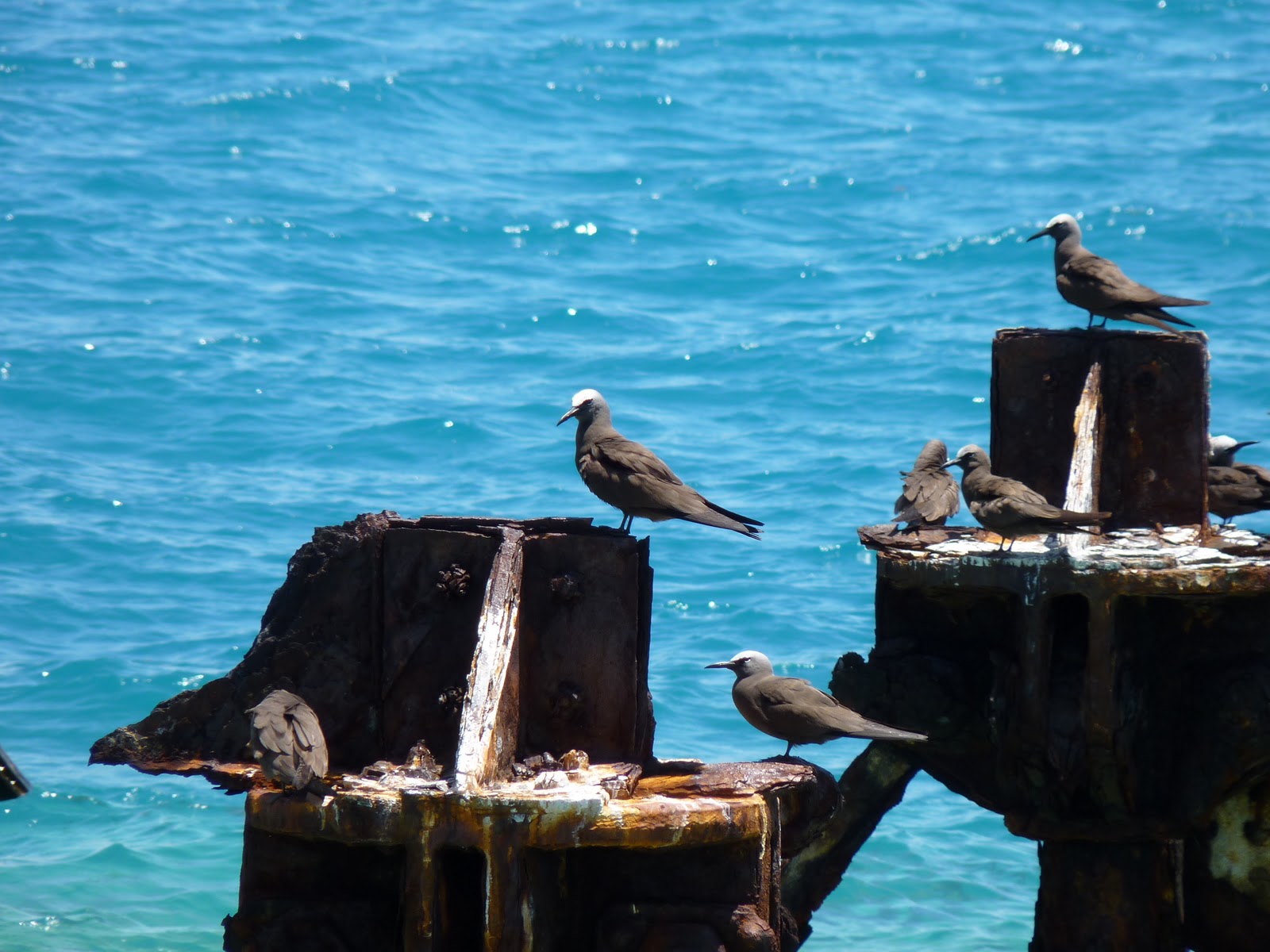
Brown Noddies occupying pylons

Female Magnificent Frigatebird

A perched Common Nighthawk is a rare sight for me.

I guess I was surprised most by seeing birds that I don't think of as being all that migratory; a Belted Kingfisher (Ceryle alcyon) and a Northern Mockingbird (Mimus polyglottos). We really hoped the mockingbird would be a Bahama Mockingbird (Mimus gundlachii). No such luck for us, but when you think of it, a Bahama Mockingbird might be more likely in a place such as this.

Other species which I enjoyed seeing were a single Savannah Sparrow (Passerculus sandwichensis) and a single Spotted Sandpiper (Actitis macularius). We also saw thrushes, tanagers, and buntings.

When our four hours on the island was finished, we reluctantly boarded to Atlantic Jefferson to return to Key West. With birders on board, the boat's captain made a brief side trip to the Hospital Key to see breeding Masked Boobies close-up. The visit was short but we had great looks at this beautiful bird.

I saw five life birds and would recommend this day trip to any birder. We had the bonus of being there during neotropical migration. I'm sure that once migration is complete, the fort would be essentially birdless. But, the sea birds would be there and as their breeding season advanced the baby birds would add to their numbers. If I have counted correctly, in all we saw 44 species of birds. That doesn't sound like many but the island is small and, of those 44, we often saw many of one species. Just for example, there were possibly a couple hundred Palm Warblers, at one point there were six Indigo Buntings perched in one tree and finally there were three Merlins present. So where ever one went there were always birds to find.

This visit heightened my awareness and belief that songbird migration really is one of the wonders of the world.

Island Closed - seabirds nesting.

Coming next - Florida: a special bird in the Everglades.

Florida: the Keys

On Sunday morning, just before leaving the mainland to travel down the Keys, we stopped at Everglades National Park, just a short drive from our hotel in Homestead. Low, dark clouds covered the sky. Enroute it began to rain heavily. The purpose of our visit was to see one bird - the Smooth-billed Ani that has been being seen along the boardwalk trail beyond the Royal Palms visitor center. Upon our arrival it continued to rain heavily. A few other birding visitors also had the same objective. Alas, it continued to rain and the ani never did show for us.


The heavy rain did not deter any of the wading birds. Green Herons (Butorides virescens) are numerous anywhere with water in Florida. The Everglades habitat is perfect for them.


As we left the trail, not far from the Royal Palms visitor center building, Bill spotted a Barred Owl pair (Strix varia) trying to stay dry beneath a low canopy of leaves. This poor, wet and ruffled owl looks miserable.

Moving on we began our long drive down the Keys on Sunday, the 18th. For a Sunday drive down the Keys we may have been helped by the heavy rain. Traffic at the top of the Keys was light and we were able to make good progress. Our first stop was at a mature mangrove woods along Crocodile creek just beneath the highway to unsuccessfully call out the Mangrove Cuckoo (Coccyzus minor).

Our next stop was at the Dagny Johnson Preserve along county road 905 in Key Largo. Here it continued to rain heavily. We saw flyover White-crowned Pigeons (Patagioenas leucocephala), a bird that I had seen in Cuba in January, 2006 but not in North America. When the rain would intermittently stop we heard, and then saw, none other than the Black-whiskered Vireo (Vireo altiloquus). The bird was only minimally cooperative, preferring to remain mostly high up and tucked amongst leaves. Finally, the rain did stop, the sun came out and just as we were leaving the vireo did briefly show itself well. The Black-whiskered Vireo was my third life bird for the trip.


The sun remained shining and the blue sky opened up. Our next stop was Long Key State Park where we again called, unsuccessfully, for the Mangrove Cuckoo. We saw some migrant warblers, but the best bird may have been long, open and satisfying looks at another Black-whiskered Vireo.

Black-whiskered Vireo

Cropped photo of Black-whiskered Vireo clearly showing the bird's "whisker."

One of the migrant warblers. Do you know which?

Arriving in Key West in the latter part of the afternoon we drove immediately to Fort Zachary Taylor State Park for a couple of hours of some terrific migrant warbler finds - all birds that we will be seeing here in a couple of weeks with the exception of one. Well, perhaps two. We had good looks at Worm-eating Warbler (Helmitheros vermivorrum); though it can be found, usually annually, it is not a common warbler in Michigan.

Bill received a tip from another birding group of the location where they had watched a Swainson's Warbler (Limnothlypis swainsonii) for a half hour. This is the only eastern warbler I have not seen and despite many distractions to look at other birds elsewhere I tried to remain focused on finding this bird. I was unsuccessful and this was disappointing because I knew the bird was in the area. At one point I briefly caught sight of a pale, plain-breasted bird on a low limb. The bird would not reveal itself again even when Bill played it's song. Another miss.

We ended the night with dinner followed by an unsuccessful try for the Antillean Nighthawk (Chordeiles gundlachii) at the Key West Community College and at the Key West airport.

Coming next - Florida: the Dry Tortugas.

Thursday, April 22, 2010

Florida: in the beginning, sunny, rainy and birdy

I have just returned from a very busy birding week in Florida. I departed on Thursday, April 15th and returned just a couple of hours ago. During my time there I intended to keep up my blog with daily postings. As it turned out the birding was so busy and the days were so full and long that I was too tired to write my blog at night. Much more important to rest up for more of the same the next day. I was just happy I could download and give a quick viewing of the photos I took each day. Additionally, the wireless internet service in some of the hotels we stayed in was spotty at best.

The trip was led by Bill Sweetman of Grand Rapids, Michigan and there were five birders along. Including Bill, four are from the Grand Rapids area and my friend, Vee Bjornson, is from Lansing.

The trip was so birdy and covered such an extensive area of Florida, that I think the only way to write about it is to split it up into themes. In this first entry I share some in the beginning photos and a narrative shell. Honestly, the week was so busy that I'll need to do a retrospective review before I can piece together all the details.

(Click on any photo to enlarge the image. Double-click for full-screen image.)


On our first evening, we went to Lake Toho... in Chisholm County Park approximately 40 minutes from Orlando to look for Snail Kite (Rostrhamus sociabilis). We did not find Snail Kites, but did see this very cooperative Northern Bobwhite (Colinus virginianus). I hear bobwhite often but I've actually seen bobwhite a few times and they are always running away so this cooperative bird was a special treat.


The ubiquitious White Ibis (Eudocimus albus) - flying overhead, in fields, in ponds of all sizes, at the roadside and even in someone's residential front yard. The above photo was taken at Merritt Island. Apparently, this is Florida's most numerous wading bird.


This is not really my best photo of a Reddish Egret (Egretta rufescens) but I include it because it shows the bird doing what Reddish Egrets do so well and so entertainingly. In contrast to the White Ibis, we saw only two Reddish Egrets - this one above at Merritt Island and another on Marco Island.


Leaving Merritt Island we trolled slowly along a road in Florida Scrub Jay (Aphelocoma coerulescens) habitat until three very cooperative birds were spotted. Two were close enough for photos and this is the best that I was able to get.


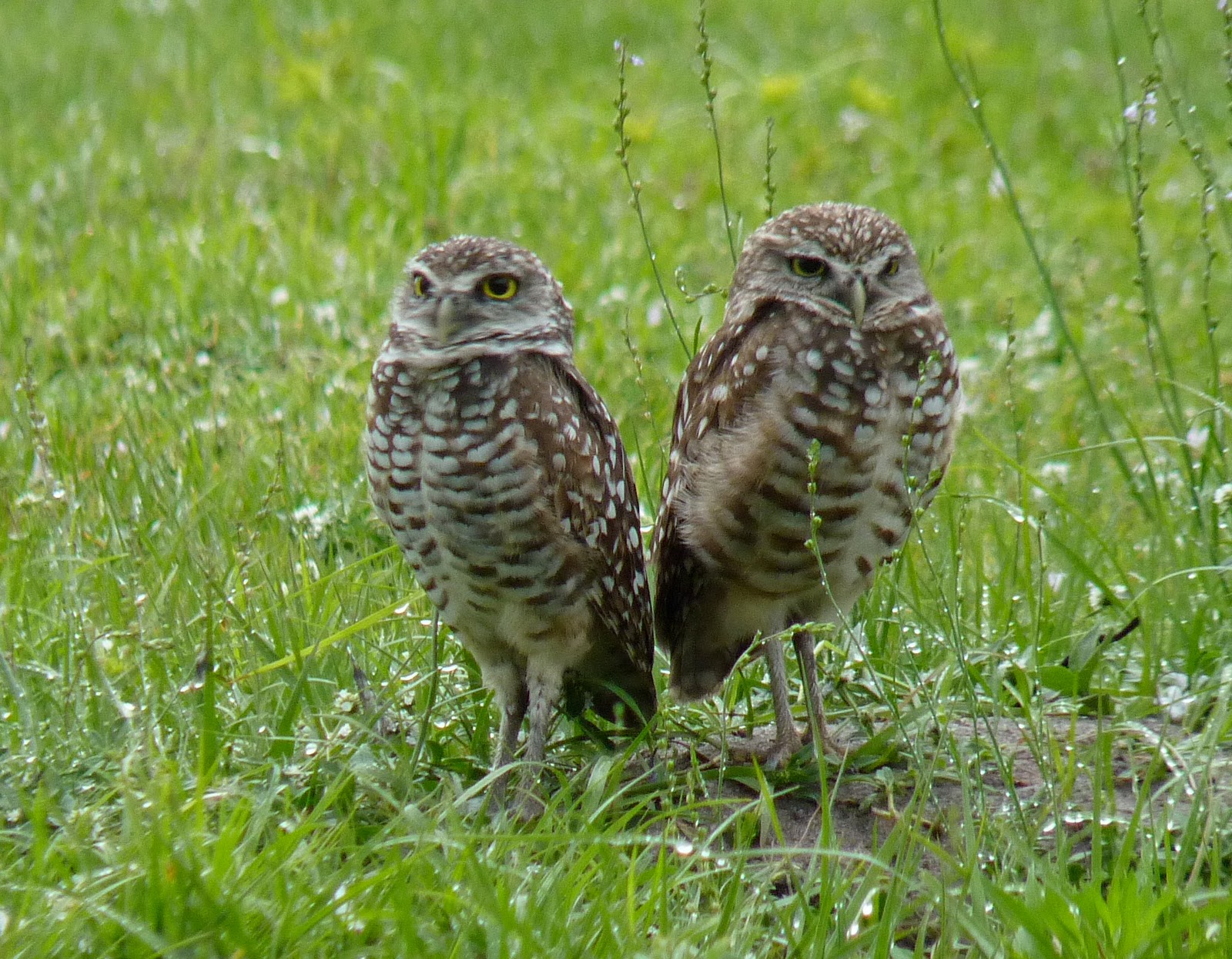
My heart goes pitter patter. After looking for Burrowing Owls (Athene cunicularia) in Arizona, California, Texas, North Dakota and Montana ... finally, I saw these two in at Manatee Elementary school yard in a town named Boynton Beach. I had seen Burrowing Owls in Peru, but these were my first in North America. The story of our search for these small and charming owls is interesting and comical but too much to go into here.


We saw all of the wading birds and most in amazing numbers and many, because of the great settings where we viewed them, offered numerous photo opportunities. I had to be ruthless with the delete key when reviewing my photos for keepers. I thought this Great Blue Heron (Ardea herodias) photo was completely comical. We arrived at Wakadohatchee Wastewater Treatment Facility - just one of several of Florida's beautiful wastewater treatment facilities (no kidding!) - just after a heavy rain had left this guy looking quite ruffled.


This Glossy Ibis (Plegadis falcinellus) in the same wastewater treatment ponds was also just one of many seen, although most others were seen while driving by Florida's many flooded farm fields and roadsides.


In the Rallidae family we saw American Coot (Fulida americana) and Common Moorhen (Gallinula chloropus) - probably the most common - in all fresh water places. Several Purple Gallinule (Porphyrio martinica) were also seen at Wakadohatchee. Curiously, we neither saw nor heard any of the rails despite birding in excellent rail habitat. It is likely that the most common rails, Virginia Rail (Rallus limicola) and Sora (Porzana carolina), had already migrated north.


Of course, this female Red-winged Blackbird (Agelaius phoeniceus) is not a special bird but I love this photograph. It's also an excellent example of some of the photo opportunities I was offered.


Not to be excluded, her male counterpart was photographed the next morning at the same place.


One of my favorite shorebirds, there were two Black-necked Stilts (Himantopus mexicanus) at Wakadohatchee.


I love this Tricolored Heron (Egretta tricolor) photo. It does not show the beautiful blue at the base of the bird's bill, but the bird's shadow and the circle in the water seem very nice to me. To take this photo, I was looking down at the bird from the boardwalk.


Can you spot the bird? This Least Bittern (Ixobrychus exilis) was on her nest right along the boardwalk. As beautifully camouflaged as the nest was, I fear that her wide-open eye reveals she was receiving more attention than her comfort level could tolerate. Because of its extensive boardwalk design, the Wakadohatchee wastewater facility was also a popular spot for photographers and non-birding walking visitors.


Moving further south, we saw Common Ground Doves (Columbina passerina) in a few locations, but this bird perched on a low branch at Bill Baggs State Park in Biscayne Bay just long enough for me to snap this one shot. In this park we also saw a few warblers, but spent most of our time searching for a LaSagra's Flycatcher (Myiarchus sagrae) that has been being seen there. We ran into a birder from Calgary, Canada who had seen it the day before and he also reported that the park ranger had heard it at 10:30 am on the the day of our visit. Alas, we did not see the LaSagra's Flycatcher.


I saw my life Gray Kingbird (Tyrannus dominicensis) perched and chattering from a high utility wire on the University of Miami campus. This is the best I could do for a photo. Curiously, I saw only two other Gray Kingbirds, also perched on utility wires, as we drove through the Keys.


Finally, another life bird, also on the University of Miami campus (incidentally, a very impressive-appearing place), this Spot-breasted Oriole (Icterus pectoralis) was very cooperative. This was at approximately 5:00 pm when there was still a lot of activity on campus. Six birders dashing around the lawns and a parking lot attracted the attention of more than one person and a few came up to ask what we were looking at. True to its oriole heritage, the Spot-breasted is a stunning bird.

Coming next - Florida: the Keys.

Monday, March 8, 2010

Final California birds

I'm in San Diego International Airport where they have free wi-fi waiting for my red-eye flight and taking this time to make some final observations.

It was cold and rainy today. After the conference ended in the early afternoon, my colleagues and I went to the San Diego Zoo in Balboa Park. We got caught out in two or three heavy rain showers. We could actually see our breath. This is not what any of us expected for our trip to San Diego. With all the rain they've had here the area is incredibly green and beautiful. My colleague found out from a telephone call to her husband that it is sunny and 60 degrees back in Detroit. That's certainly better weather than we've experienced here for the past two days.

Still managed to get out for a few more birds. On the walk to the beach this American Wigeon (Anas americana) was with a partner in an area near a small bit of water between resort buildings.


In all I saw about a dozen Marbled Godwits (Limosa fedoa) feeding along the sandy shores of the beach areas of our conference's resort island called Paradise Point.


There were also two Willets (Catoptrophorus semipalmatus). I chased this one around and finally got this photo. The above two birds stuck together along the shoreline.


After taking photos of the godwit and the willet I continued walking along the beach. Suddenly a large flock of big black and white birds flew in low over the water looking for a place to land. These were followed by a second large flock. When they finally settled down on a sandy point I estimated there to be about 130 Black Skimmers (Rynchops niger) - comical and completely enjoyable birds. These birds were migrating because their main interest seemed to be rest, not skimming.


The photo is fuzzy around the edges, but this Western Grebe (Aechmophorus occidentalis) was floating quite far out.


This loon was also quite far out into the water for this photograph. I was hoping it to be a Pacific Loon (Gavia pacifica), but when I downloaded the photo I saw that it was a Common Loon (Gavia immer) which also has a significant west coast presence.


I continued to walk along and suddenly this bird flew in seemingly out of no where - Long-billed Curlew (Numenius americanus). What a thrill! It didn't like me taking photos, however, because it flew away almost just as quickly. I had time to snap only a few shots.

Off to the San Diego Zoo this afternoon. Just as we walked in there was a large group of noisy flamingos - don't know which. Very red, very big. In their enclosure, which was essentially open, were a variety of waterfowl - not all property of the zoo. Free flying Mallards, Hooded Mergs, Wood Ducks, Northern Pintail and Cinnamon Teal, Great Egrets were just a few of the fly-in visitors hanging out. There were also two zoo-resident Scarlet Ibis. One of my favorite ducks was a zoo resident - White-cheeked Pintail (Anas bahamensis) - which I have seen in the wild in Peru. I think this is a completely charming duck. Mandarin Ducks (Aix galericulata) were in another enclosure and they are quite possibly the craziest looking duck I have ever seen. All of the zoo ducks were banded, but it was still difficult to discern what would prevent them from escaping.


Lots of non-zoo residents were in the zoo. Those that come easily to mind - Song Sparrows, California Towhees, Black Phoebes and none other than Anna's Hummingbirds were everywhere. Again, I'm struck by how different this Song Sparrow (Melospiza melodia) appears.


Back to Paradise Point for a final meal and to collect our luggage for the trip to the airport. I had just enough daylight remaining to capture this photo of a Heermann's Gull (Larus heermanni) in one of the resort ponds. My new favorite gull.


If I counted correctly, I saw 88 species, three of which were life birds. Successful trip. Good trip. Glad to be going home.