Saturday, July 24, 2010

Butterflies of Matthei Botanical Gardens

Along with Roger Kuhlman and Roger Wykes, five people showed up for the rained out Washtenaw Audubon Society butterfly field trip at Matthei Botanical Gardens this morning.  The field trip has been rescheduled for next Saturday, 07/31/2010, but the seven of us decided to stick around to see what we could find.  Despite the less than desirable weather for butterflies, we still managed to find twenty species.  Additionally, there was a hummingbird moth and a few different kinds of dragonflies.

Below are some of the photos I was able to take - a sneak preview of sorts.

Pearl Crescent (Phyciodes tharos)

Least Skipper (Ancyloxypha numitor)

Peck's Skipper (Polites peckius)

Appalachian Eyed Brown (Satyrodes appalachia)

Wood Nymph (Cercyonis pegala)

American Copper (Lycaena phlaeas)

Monarch (Danaus plexippus) catepillar

Viceroy (Limenitus archippus)

Female Widow Skimmer (Libellula luctuosa)

Giant Swallowtail (Papilio cresphontes)

Dun Skipper (Euphyes vestris)

Tawny-edged Skipper (Polites themistocles)

American Painted Lady (Vanessa virginiensis)

Tiger Swallowtail (Papilio glaucas)

Thursday, July 22, 2010

Great Britain: a few critters

No narrative.  Just photos.

Garden Tiger Moth (Arctia caja) catepillar

Wings closed - Speckled Wood (Pararge aegeria) along Nevern Estuary in Pembrokeshire, Wales

Small Heath (Coeronympha pamphilus) near Skomer Island

Common Blue (Polyommatus icarus) near Slimbridge

The Springwatch website offers a photo essay of some other butterflies found in England.  I had hoped to see a Peacock - but, no luck.

Out of focus  Four-spotted Chaser (Libellula quadrimaculata), Minsmere RSPB 

Originally I identified this dragonfly as a Yellow-winged Darter.  I received a comment [below] from a Michigan friend, Allen Chartier, suggesting that the dragonfly above is Libellula quadrimaculata.  I used this website to try to make the identification.  Scroll to Family Libellulidae.  Libellula quadrimaculata does look better for this dragonfly.

Banded Demoiselle (Calopteryx splendens), photo by Cliff Young

Bombus sp. bumblebee, Minsmere RSPB

Rabbit in a cow pasture in Wales.  There is an overexplosion of rabbits  in Norfolk and Suffolk and perhaps elsewhere, too.

Red deer ? on Dunwich Heath

Roe deer at Minsmere RSPB

Land snail at Rutland Water

While I did briefly see a stoat as it ran across a road, I never did see a hedgehog.  I wanted very much to see a hedgehog, but this is best done at night.  In any event, it also seems they are in decline.

Sunday, July 18, 2010

Observations on birding in Britain

I recall once, in southwest Michigan, standing no more than five feet from a singing Connecticut Warbler (Oporornis agilis) and still being unable to see the bird.  So frustrating!  I didn't know when to walk away. If I stayed for another two minutes, would the bird come into view?  I have seen female and juvenile Connecticut's, but to this day, have never seen an adult male.

I was reminded of the singing Connecticut Warbler experience when, at Titchwell RSPB, a burst of song actually startled me as I walked on the trail right next to the bushes from where the song came.  Then, silence and no sign of a bird.  I walked away and behind me, again, the same burst of song.  A Brit walked by and knowingly said, "Cetti's" - turns out, a hard to see little bird, Cetti's Warbler  (Cettia cetti).  Later at Minsmere, with the help of Malcolm's patience, I finally did get a couple of brief glimpses of the Cetti's.

I sent a postcard to my young birding friends, Harold Eyster, and his sister, Artemis, in which I wrote "birding for little birds is hard in England."  Thinking back on this statement, I'm not sure it is exactly accurate.  The beginning of June is well past spring migration and the passerines were into their nesting and fledging of birds.  Many may have already started on their second brood. With one exception, the tits, I guess a more accurate observation may be that it just seemed difficult. The tits, like our chickadees, were commonly heard and seen moving with and feeding fledglings.  But others, like the Cetti's, Sedge and Garden warblers, Chiffchaff - were most often heard only.  Still others, like Wood Warbler, Willow Warbler, Grasshopper Warbler, Goldcrest, Whinchat and Common Redstart that, by their range maps seem well-distributed, were neither heard nor seen.

Others, like the Gray Wagtail and the Yellow Wagtail, certainly seemed like they should have been possible somewhere in all the places we visited.  But I need to keep in mind that, with the exception of my weekend with Malcolm and Angela at Minsmere, where we had time to find birds properly, the other parts of my trip were not focused on finding small birds.  This is how habitat specialists get missed.  One needs to take the time to find them in the right habitat.

                  
Birding for inland gulls, terns, waders and waterbirds is done from uniquely well-designed "hides" such as in the photo above.  The hides have ledges where a spotting scope with a specially-designed monopod with an clip can be attached.  In every RSPB location a hide was available at the best viewing vantage point for that particular pond. Even the local county parks near Leamington Spa we visited had viewing hides.  From these hides, we also saw Marsh Harrier, Kestrel and Hobby hunting over the marshes.  For our Minsmere weekend each hide we entered was typically very crowed.

The Royal Society for the Protection of Birds (RSPB) is an impressive organization with an extraordinary array of birding and wildlife sanctuaries located throughout Great Britain.  The popular BBC television show Springwatch is anchored from the Pensthorpe Nature Reserve and one of the show's hosts is Kate Humble, the currently appointed president of the RSPB.  We were able to watch two Springwatch episodes during my visit and each show was excellent. While I would not recommend the Pensthorpe Nature Reserve to the hard core birder; Great Britain has, for such a small country, certainly made a consolidated and impressive effort to preserve and reserve valuable land for the protection of birds and wildlife.  And, with the Springwatch television show, they bring the conservation and importance of Britain's wildlife to the public in a very tangible and accessible way.  I wondered if the Audubon Society hosted such a series on PBS, would it be so eagerly watched and so popular?  There are many important lessons that the innumerable and splintered conservation groups in the United States could learn from the RSPB.  I think about this as I open my mailbox daily to find my tenth request of the year to financially support X, Y or Z conservation organization.  I have often wondered, given the confusing madness of American conservation organizations, if we really make any significant headway toward saving habitat or otherwise helping birds and wildlife.

Final comment about RSPB reserves:  the larger reserves have full-service cafes and gift shops.  The few small souvenirs that I bought home were purchased at one or the other of the gift shops.  The best cream of asparagus soup that I do believe I have ever eaten was from the Minsmere cafe on Sunday, our final lunch there.  No kidding!

Great Britain, being small and densely populated, has a lot of roads. Additionally, as is famously known, they drive on the left side of the road.  The roads are designed and structured very differently and, surprisingly, relatively little of the driving we did was on motorways. Brits, if they travel much on the continent, are skilled right side-of-road drivers.  Angela and Malcolm frequently take their small caravan (RV) for vacations on the continent, and when Malcolm was here I noted that he was a very capable and confident right side-of-road driver.   Cliff and Joy have lived in the United States and Joy, at least, would rather drive in the States.  It's hard for me to imagine that the same would be true for American birders visiting England.  It's just too different.  I can think of only one birder, Karl Overman, who might be successful. Check out Karl's website and click on his Oman trip report for why I suggest this.


So, for the visiting birder, the challenge is getting around the country safely, in a time efficient manner and not getting lost enroute.  Even having a GPS is not a guarantee to getting from one location to another. Joy and Cliff would get mad at their GPS and turn it off.  So, as was my luxury, it may be best to have a Brit doing the driving.

Here we often bird from the side of the road and every birder I know will pull off the road in a New York minute if they see reason to do so.  Not in England.  First, the roads are just too crowded.  No matter how remote you think you are, you are never the only car on the road.  And, because the Brits are comfortable driving on small narrow roads, they drive fast on these roads.  I was frequently amazed to see cyclists also riding on the narrow roads - often without a helmut.  I don't know what the car/cyclist mishap rate is, but it must be significant.  Secondly, there is no where to pull off the road.  There were a few times when I saw quail-like birds (possibly Common Quail or Gray Partridge) in a field or at the side of the road and would have loved to pull off to scan with my binoculars.  It was just not going to happen.

Another reason RSPBs are so popular for birders is because all of the other open land, (other than county parks, walking trails and coastal paths), is private property.  Here, under normal circumstances, most birders I know do not trespass on private property.  But, I think there are situations when we all might trespass.  I don't think it's the same in England.  Private property really means private property and I don't think they trespass.

Other than one Scottish crossbill species, Great Britain does not have any other endemic species.  A world lister would do just as well to visit the continent.  But for an anglophile like me, birding in Great Britain offered a special opportunity to see the countryside and charm (cliched as it is, England and Wales have charm to export) of such a small, yet beautiful country.  The opportunity to bird with friends also made it more enjoyable for me.  I had visited Great Britain five times before (twice for extended stays), but not more recently than nineteen years ago.  This year may be my last time there to reconnect with friends and to see a country that has changed enormously and continues to change right before your eyes.  But, as much as it has changed, it also seems to manage to retain that which makes is so uniquely appealing.

Thursday, July 15, 2010

Baby birds


No, this is not a baby bird.  It's a Rook (Corvus frugilegus) and common, apparently.  I admit that, with the exception of Red-billed Chough, I did not pay much attention to crow-like birds - Jackdaw, Carrion Crow or other.  I did, however, want to see a Rook well. Perhaps I was seeing Rooks all along but was not paying adequate attention to identify the unique bill and face.  

After leaving Wales and before returning to Leamington Spa, we took a slightly longer route back to make a brief visit to Slimbridge Wildlife Trust in Gloucestershire.  There were scattered trees in the parking lot and when I got out of the car I noticed the perched bird above.  It then flew to a leafed tree nearer to where I was standing and I took the photo below in which the bald face is obvious.  Finally, a Rook. Honestly, despite how common they are, this is the only one I really saw in my whole two week visit.


At the beginning of June nestlings and fledglings are everywhere and relatively easy to see and or hear. If there were adult birds around, they were likely to be seen moving and feeding with their young.    


The juvenile Magpie above was seen at Titchwell RSPB.  It was smaller and had a shorter tail than an adult bird, but otherwise there was not much difference.  Although it was clearly able to get its own food it was still begging.


Probably the cutest and most enjoyable to watch were young Avocets. They fed like their parents with the same sweeping action though this did not yet appear to be quite as efficient. They seemed to remain generally close to an adult bird but if they got too distant a parent bird would wade closer to check on the young bird.   


Hard to imagine how the advocets did so well to raise young with the hundreds of breeding and, probably voracious, Black-headed Gulls also breeding in the same habitat.  The bird above is a downy Black-headed Gull.


There appears to be a fuzzy, little tennis ball just to the left of the Oystercatcher.  But, as can be seen in the photo below, there are actually two Oystercatcher babies.  Oystercatcher was seen commonly at all locations throughout my trip - here at Rutland Water.
    

Fuzzy little Common Moorhen at Rutland Water.

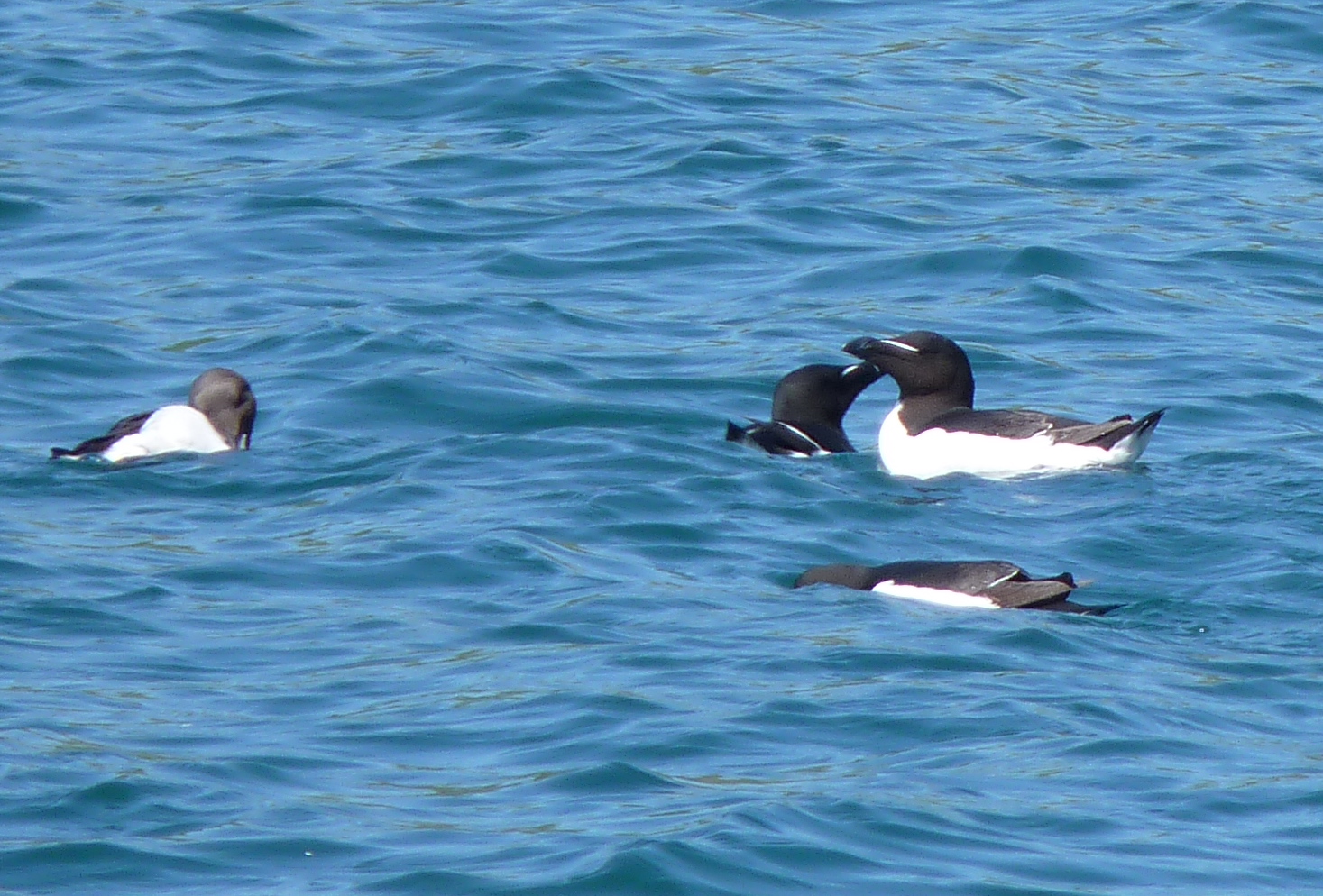
Begging Razorbill

On Ramsey Island there were many fledged Wheatear.


Adult Pied Wagtail (Motacilla alba) were around in a variety of locations.  Early in the morning I saw them feeding in the grass, but they were, at least for me, impossible to sneak up on for a close photo.  So when on Ramsey Island the RSPB staff told me that a Pied Wagtail had fledged from its nest behind their building earlier in the morning, I went out immediately to find the bird.  It was already a skillful flyer.

Newly fledged Pied Wagtail

Father Chaffinch feeding fledgling.


I saw all of the tits (with the exception of the Crested Tit which is only in northern Scotland) and most often I think they had fledglings with them.  The tree stump above has a cavity just left of center which housed nestling Blue Tits (Parus caeruleus).  But why include a photo of a tree stump with invisible nestlings?  Both parents were feeding the nestlings and were completely bedraggled and frenetic with the activity.  Each time they approached or left the cavity, which was often, they would perch on the stump just above the cavity.  I must have tried two dozen times for a photo of the perched parent Blue Tit before giving up.  I include a photo of the stump for the memory of this frustrating experience.        

Bringing up the rear, Greylags with goslings were common at Rutland Water.

Monday, July 12, 2010

Ramsey Island

Wednesday, 06-16-2010, was our last full day in Pembrokeshire.  Today we would try for Ramsey Island.  A return to Skomer Island was possible but too risky secondary to the fact that it was further away and there would be a chance that, again, there would be no island landing.

Our Ramsey Island plans also offered us the opportunity to see St. Davids.  St. Davids is the smallest city in the United Kingdom.  Cliff explained that in the United Kingdom a place cannot be a city unless it has a cathedral.  So, for example, Leamington Spa, despite its significant size and population, remains a town because it does not have a cathedral.  Conversely, St. Davids is really only the size of a village, but it has a cathedral so it's a city.


For good reason, St. Davids is also a large tourist destination.  We stopped first at the visitors center where we received information about obtaining tickets for the boat to Ramsey Island.  The ticket office was only a five minute walk from the visitors center and took us down the main street.  We found the ticket office and purchased our tickets for a noon departure from the coast guard ramp.  


Since we had time, we walked a little around the city and to the cathedral.  We also stopped at a local shop to purchase freshly made sandwiches for lunch.  


On a building that led into the cathedral grounds I got my first good opportunity for Jackdaw (Corvus monedula) photos.  For some reason, I think of the jackdaw as being a medieval bird.  They fit in well with the cathedral mileau and were nesting in the window slates of the ancient stone building.  Note the blue eye.  


We arrived early at the the Ramsey Island departure dock and had a brief chance to walk a bit of  the coastal trail.

Another Common Whitethroat

  
This whitethroat has good taste for scenic views

While waiting for the boat to unload with a group returning from the island, we learned that there is a friendly rivalry between the Ramsey Island staff and the Skomer Island staff.  The young Ramsey Island ticket collector and all-around assistant and dock organizer commented, "Ramsey is better than Skomer.  Skomer is flat."  We also learned that there had been a successful landing on Skomer Island today. 

The boat ride to Ramsey Island is a straight shot from the mainland dock to the island dock and only about ten minutes long.  We exited the boat and walked up a tall stairway along the side of a cliff and into a small RSPB building where RSPB staff passed out maps and gave us a brief introduction to the island and what we would have an opportunity to see. 

From this point we set off and walked all around the island.  Ramsey is not flat.  We hiked from one beautiful scene to another.  There are small peaks to climb for long views of the ocean and the mainland beyond.  It is a place where every ten steps offers a new photo op.     

Sheep resting on stone wall

Northern Wheatear (Oenanthe oenanthe)

Northern Fulmar - unfortunately the best photo I could get.

Typical Ramsey Island view

Ramsey Island coast

Red-billed Chough with red legs visible.

Ramsey island has seven pairs of breeding choughs.

RSPB headquarters on the island

Other birds seen were more guillemots, kittiwakes, kestrel, lots of wheatear, meadow pipits and rock pipits.  At our introduction to the island, we were tipped off to look for Little Owl hunting from the stone walls, but we had no luck finding one on this day.

Leaving the island was difficult.  I knew I had been given this one chance to visit and, for such a nice place, it was not long enough.  I had a twenty pound note in my pocket and wanted to give a donation.  The RSPB staff suggested that I join the RSPB even though the typical membership costs about 36 pounds per year.  I filled out the form and she gave me a membership kit which included this year's February and May publications.  It will be interesting to see if I get mailings from the RSPB over here.  If possible, my plan is to try to continue the membership.

On Thursday morning, 6-17-2010, we departed Pembrokeshire.  The sun was shining. 

Dawn view from my window with the putting green in the foreground

Anecdote:  I flew home on June 19th and returned to work on the 21st. For most Americans two weeks is a long vacation, and so it was nice to notice that I had been missed.  "Oh, your back!  How was your vacation?" was the comment/question I heard most in the first couple of days after my return.  One of my physician colleagues, however, had been paying attention.  She had a confused look on her face and said, "I thought you were going to England."  I replied, "yes, I did go to England."  To which she responded, "but, you're suntanned."  
    
Next:  Baby birds