Friday, February 14, 2014

Alas, leaving the highlands - day three

In early January I met up with a Detroit friend who had twice been birding in Costa Rica.  I told him I was going at the end of the month and he was effusive with his comments stating, "Costa Rica is a great place - so birder friendly."  Of course, it's easy to know that Costa Rica is worldwide famous for  birding.  It's another thing to experience it.


Something about this rustic sign was so appealing.  On the one hand, a little broken down; on the other, so representative of the importance of the natural environment to the well-being and economy of Costa Rica.

We came upon the sign along a muddy trail while chasing down the elusive Silvery-fronted Tapaculo (Scyalopus argentifrons).  We heard the bird vocalize, and saw it in quick flashes while it remained true to its tapaculo nature.  

Then we had an unexpected surprise when Vernon heard a Resplendent Quetzal calling.  We found the female high up in a tree and then saw the male bird fly over the tree with bright blue sky as backdrop to see its beautiful, streaming uppertail coverts.     


On our final morning at Savegre, the end of our morning walk gave us two good birds.  A family of Spotted Wood Quails (Odontophorus guttatus) was working the leafy ground for food.  


Coming out of the woods and with breakfast in mind, I heard a new vocalization.  This was quickly identified for us by Matt and others who knew to look up to find a couple of Emerald Toucanets (Aulacorhynchus prasinus) feeding - the only ones we saw on the whole trip.  Wow! 


Spotted Wood Quails and Emerald Toucanets inspired a celebratory breakfast with huevos rancheros, beans and rice, white cheese for the Europeans and some typical savory pastries.  Most breakfasts and lunches were vegetarian.  


I found woodcreepers, treerunners and treehunters to be the most difficult group of birds to identify.  We saw a lot and many several times, but so challenging to stick the identification.  Above is a Ruddy Treerunner (Margarornis rubiginosus),    


Up over 10,000 meters to find some high elevation specialities, this thick bed of clouds rolled in.


I think we missed three target species before finally finding this Volcano Junco (Junco volcani).


Resplendent Quetzal is everywhere in the highlands.


In the fields behind our lunch stop restaurant, this orange fruiting tree was full of birds seen well through the spotting scope.
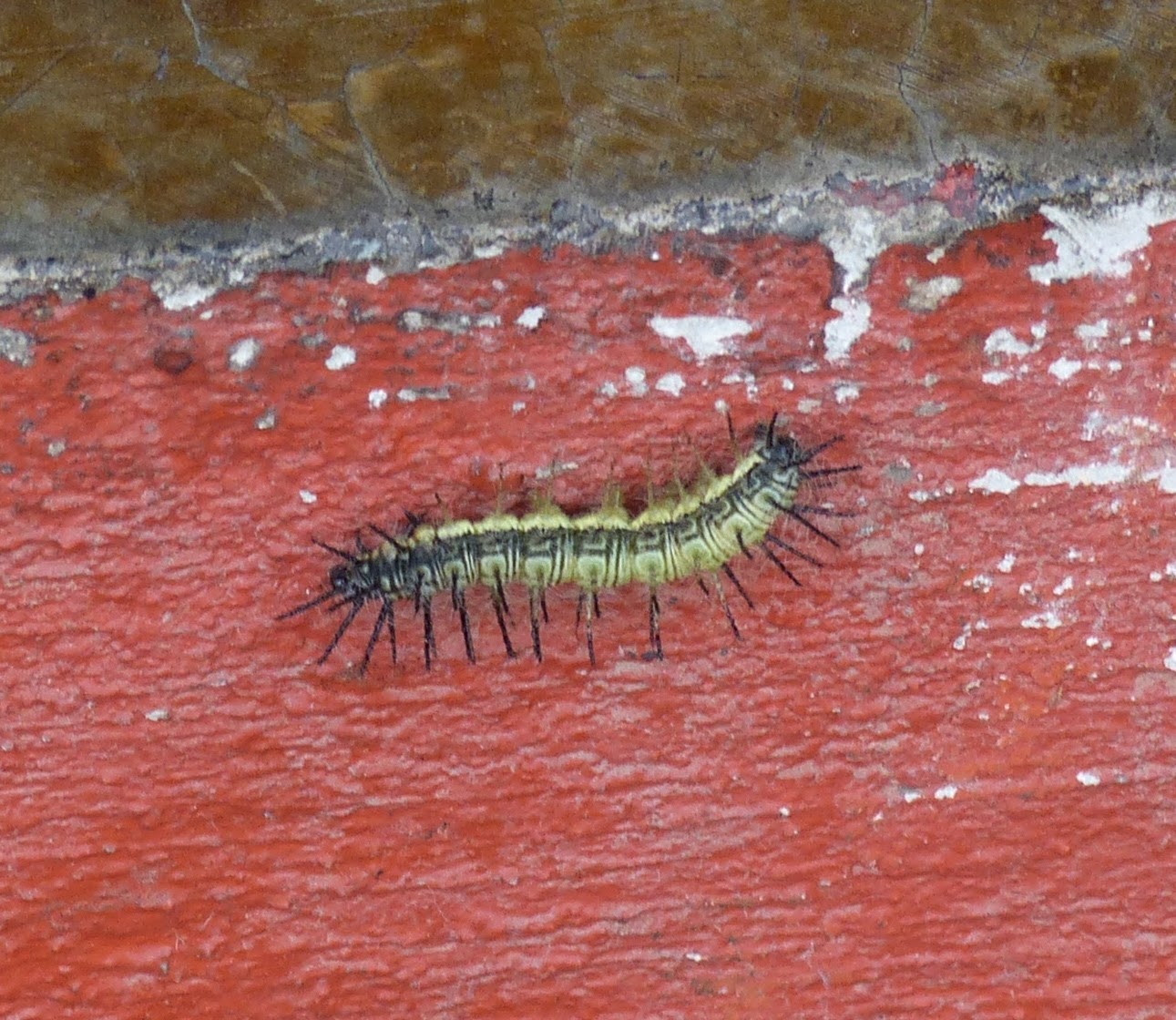

Caterpillar.


A cluster of lemon and orange trees just off the deck of our lunchtime restaurant invited great birds to pose for photographs.  Tanagers are such amazingly patterned and colorful birds.  This Golden-hooded Tanager (Tangara larvata) posed in the orange tree.


I was not expecting or even thinking about Red-legged Honeycreeper (Cyanerpes cyaneus).  So beautiful!


I was thinking about Green Honeycreeper (Chlorophanes spiza) even less.


Red-crowned Woodpecker (Melanerpes rubricapillus) rounded out birds photographed in the orange and lemon tree grove.


A cattle truck leading us to the rainforest.

To be continued ...

Wednesday, February 12, 2014

Los Roblas trail and night birding - day two

Our second full day of birding the highlands from the Savegre Lodge left me with the impression of this area being my favorite of the trip.


The river around Savegre Lodge.


I love this photo of the Slaty Flowerpiercer (Diglossa plumb).  I don't remember taking it and for me, even though we saw it many times, this bird was difficult to view clearly through my bins, much less get a clear photo with a berry in it's bill.  Wait - stop the presses!  Just received a comment from Matt (below), telling me the bird above is a Mountain Robin (Turdus plebejus).  I does look a robin, doesn't it?  I didn't even have Mountain Robin listed as one of my seen birds.  Reveals the perils of photographing a bird before actually seeing it!  


Common Bush-Tanager (Chlorospingus ophthalmicus).  A terrible photo to be sure, but the triangular white spot behind the eye is visible.


Ruddy-capped Nightingale-Thrush (Catharus frantzii), above and below, was found by Sandy and it flew into a spot where I could get these beautiful photos.  Note the bi-colored bill differentiating it from the Black-billed Nightingale-Thrush.  


Not a very good photo, but Yellow-winged Vireo (Vireo carmioli) was a bird seen commonly in the highlands, especially around the lodge.


This crazy photo is of a soaring Ornate Hawk-Eagle (Spizaetus ornatus), just to remind me we saw it.  A distant flyover photo cannot reveal this, but it's a pretty dramatic-appearing bird.


Spangle-cheeked Tanager (Tangara dowii).  Now there's a name.


Our fearless leader.  Vernon Campos has an incredible work ethic.  His goal, plain and simple, was to get us on the birds and teach us some Spanish along the way.  Vamos!


As yet another unidentified butterfly.  A note on photographing the butterflies we saw.  Difficult.  The above butterfly and a few others were exceptions, but mostly they did not land.  I had intended to photograph as many as I could, but from day one I saw that this was going to be difficult and abandoned my plan.    I thought that the propensity of the butterflies to flit rather than land might be a life-saving adaptation that keeps them from becoming bird food.  


I love flycatchers - maybe my favorite genre of birds - and Costa Rica does not disappoint.  We saw over half of their 80 species of flycatchers.  I was thrilled with this photo of a Yellowish Flycatcher (Empidonax flavescens).


On the morning of our third day, this was our ride up to the top of Los Roblas trail, elevation 10,500 meters, to bird the trail on the walk back down.  


Unidentified beautiful flower.  


Bromeliad?


Look closely to pick the Flame-throated Warbler (Oreothlypis gutturals) out of the other colorful junk in this photo.


Our first evening meal at Savegre Hotel dining room buffet.  100% of the time, our food was very good.  Reminded me, yet again, that Americans eat plastic and cardboard.


Another Tufted Flycatcher.


As already written about flycatchers, I love this photo.  Black-capped Flycatcher (Empidonax triceps).


Black Vulture - kind of cute.


Torrent Tyrannulet (Serpophaga cinerea) - a bird I really wanted to see and we saw only this one.


Charming, cute and clownish, the Collared Redstart (Myioborus torquatus) was ubiquitous in the highlands, and as is apparent from above, difficult for me to photograph.


Collared Trogan (Trogan collaris), the first of our six trogan species. 


The Ochraceous Pewee, already mentioned from day one, and the Costa Rican Pygmy-Owl (Glaucidium costaricanum) are two of the most desired specialty species seen in the highlands.  


Another view of Costa Rican Pygmy-Owl.  What a great bird!


Dusky Nightjar (Antrostomus saturatus), another highland specialty, provided us with a thrilling chase on our owling night in the highlands.  

We also had long, satisfying looks at a Bare-shanked Screech-Owl (Megascops clarkii) and at a stunning Mottled Owl (Ciccaba virgata). My camera cannot handle any little bit of distance for night photos. The nightjar photo above was successful because the bird was perched beneath a street light, we were relatively close and Vernon had his powerful night light focused on the bird.

To be continued ...

Tuesday, February 11, 2014

Enroute to Savegre Hotel and Spa

I realize that I have enough blog material to last me awhile!  This is my third Costa Rica blog entry and I am still only halfway through the first day.  I haven't even fully reviewed all of my photos yet.  

Ours was the real deal birding trip; 6:00 am to approximately 6:00 pm and then often owling afterwards makes for a busy birding day with lots of photographs.  

After we left the Los Robles trail and lunch at the Paraiso Lodge we moved on the Savegre River area.  Without equivocation, this was an amazing birding location.  We would be here for two nights and two full days of birding.  Full of birders from many countries - Britain, Germany, Sweden, ... and others - this was a rocking place.


A charming house along our route.

But first we stopped at Dona Miriam's Restaurant, a sweet little roadside spot, not to eat but to bird along the deck stretched across the back of the restaurant.  The feeders kept by Miriam attracted great birds and opportunities for photographs.


Unfortunately, I didn't take a photo of Miriam's restaurant, but I did get one of this sign across the road.  


Acorn Woodpecker (Melanerpes formicivorus), completely clownish, handsome and charming!


Yellow-thighed Finch (Pselliophorus tibialis).  Not a great view, but the best I have.  This is a unique and very attractive bird.  The bird's left yellow thigh is just barely noticeable in this photo.


Flame-colored Tanager (Piranga bidentata) - seen many times.


Cute, little Red-tailed Squirrel (Sciurus granatensis).  Beyond cute - adorable!


Displaying female Large-footed Finch (Pezopetes capitalis) above. How do I know this bird was a female?


Because soon after the male Large-footed Finch above swooped down to have a brief mating spell with the female flirter.  I missed the act with my camera.  However, after the act, the male bird just posed and posed at the end of this twig.  The above photo reveals how aptly named this bird is.  


We saw Sooty Thrush (Turdus nigrescens) a lot, but I had only one opportunity for good photos.  I got three of this bird and the one above was the best.


Arrival to the Costa Rican highlands birding mecca!


The Savegne Lodge gardens with the lodge rooms kind of visible.


Above and below, two views of the Scintillant Hummingbird (Selasphorus scintilla).


White-throated Mountain Gem (Lampornis castaneoventris).  What a name!


Black Guan spotted by Matt high up in a tree then, as it flew down to the river, chased by all of us for photos.


Flame-colored Tanager.  Again?  Life is tough!


Palm Tanager (Thraupis palmarum) - a beautiful, silver bird.


Silver-throated Tanager (Tangara icterocephala).  

The highlands, to be continued ...