Sunday, September 17, 2017

There's a better way to help ...

I was watching the news on Friday evening and it ended with this piece.  The commentator's thoughts struck me as something that cut beyond the devastation of Hurricane Harvey.

There's a better way to help ...

I'm keeping it here so I don't lose it.

Thursday, September 14, 2017

Book Review: The Thing with Feathers

In the absence of any new blog material, and not for lack of trying - this past weekend I was in Chicago and made my way, via the Red Line, to the Montrose Bird Sanctuary (a.k.a. the Magic Hedge).  Upon arriving in Lincoln Park, I realized I had forgotten my camera battery.  I left my hotel room in such a rush and with my camera battery still in my suitcase.  Secondary to the time of day, there was no way the situation could be rescued.  C'est la vie.

However, last night I finished a very good book.  For a number of reasons, I think it's worth writing about.

Many will recall Noah Strycker's trip around the world in 2015 to see as many birds as possible.  Noah's trip was on the heels of Dorian Anderson's 2014 Green Big Year around the United States on his bicycle.  I followed Dorian's blog closely, catching up with each post just before going to bed at night.  I found it mesmerizing.  I actually felt like I had come to know the guy.  (I later met Dorian in person and realized that I hadn't come to know him at all).  I remember thinking, affected by Dorian's dramatic and brave bicycle trip of over 17,000 miles (the number of miles may not be exactly correct), how different Noah's world-wide and essentially completely fossil-fueled trip might be.

When Noah's trip was announced, with some fanfare, by the National Audubon Society who would be publishing Noah's [mostly] daily blog Birding Without Borders entries, I was immediately on board. Where Dorian had left off, Noah picked up.  Each night before going to sleep, I closed out the day with Noah's blog.  As the year went on, I knew there was a book in there somewhere.

I hadn't known much about Noah Strycker except that he was associated with the American Birding Association and that he had written a book or two.  Unfortunately, I am a skeptic about "bird books" and have often not been able to get through some of those written by even very famous authors.   But, when Amazon sent me a notification that Noah's book, Birding Without Borders, was forthcoming, I pre-purchased it ... and, why not, I also purchased The Thing with Feathers, Riverhead Books, 2014.


The first thing that struck me were the review snippets on the first three pages ...  The Wall Street Journal, "... writes like a poet," The Washington Post, "Bird journalism of the highest order," Kirkus Reviews, "A delightful book of broad appeal."  These and others by high end reviewers could not be dismissed.  

               
Noah opens his book with a introduction that is clever and captivating and I knew I was in for some reading pleasure.

    
Noah separates each essay in one of three parts:  Body, Mind and Spirit, and then further separates each into its own category.  

Of the thirteen essays included, I have three favorites:  Snow Flurries, Fairy Helpers and, my very favorite, Wandering Hearts.  He does indeed write beautifully.  While reading, I was frequently reminded of my two young home-schooled friends who  learned to observe and then apply their observations to the bigger picture of life.  Noah Strycker's large world view is full-scale in The Thing with Feathers.    

While we wait for the release of Birding Without Borders - hardcover release on October 10th - I recommend picking up The Thing with Feathers for the flavor of Noah's writing.  He's a little older now and has had more experiences.  In the meantime, The Thing with Feathers will leave you wanting more.  I think we are in for an upcoming treat. The kindle version is already available and there are ten reviews on Amazon all giving it five stars.

_______________

I do have one criticism and it kept me from purchasing The Thing with Feathers when it was initially published.  In two words:  the title.

Many know Emily Dickinson's beautiful and haunting Poem 254, "Hope" is the thing with feathers - That perches in the soul - ... ca 1861.


Many years ago I read my, arguably, favorite "bird book" ever and where Christopher Cokinos used the first line of Emily Dickenson's poem as the title of his book Hope is the Thing with Feathers:  A Personal Chroncile of Vanished Birds, Warner Books, 2000.


Though it has been many years since I read Hope is the Thing with Feathers ... I still remember how it gripped me.


Christopher Cokinos, a former president of the Kansas Audubon Council, was already an award-winning writer and poet when he wrote Hope is the Thing with Feathers ... .  Of the book the Washington Post Book World wrote, "Eloquent and moving ... a charming narrative that is both personal and historically meticulous."   The Boston Globe wrote, "resounds with excitement."  And, the Chicago Tribune wrote, "A eulogy, a call to conservation, and a careful history."


In addition to the three extinct birds above, he also writes about the Passenger Pigeon and the Labrador Duck and the Great Auk.

Though Noah Strycker's title is not exactly the same, it's certainly close enough. I'm a little surprised his editor and publisher allowed it.  Perhaps I'm nitpicking, but another title may have given Noah's book more distinction.

I love good writing and I love non-fiction and I love birds.  Both of these books have all three.      
       

Monday, August 28, 2017

A special dragonfly on Belle Isle

Found on the south side of the woodland trail on Sunday, 08/27/17 - my Green Heron day - see my prior blog entry.


I first saw the dragonfly on the asphalt trail.  I haven't really seen that many species of dragonflies so it was easy to know that this was one I had not seen before.  Just after taking this photo my camera began to malfunction a little.


But the dragonfly remained in place while I got my camera functioning again.


I could see the clubtail on this dragonfly so I hoped that this would be my first clubtail.


When the dragonfly flew it was only a short distance to some vegetation about 4 feet off the ground.  I knew my photos from the asphalt would not be good so this was photo luck.


Once landed on the vegetation, I knew my photos would be much better with the contrast of the dark dragonfly against the bright, green leaves.


I had no idea what it was, but I thought I would be able to easily identify it when I got home.


I looked through the Stokes Beginner's Guide to Dragonflies (2002), a small, handy little book with some of our most common dragonflies. On page 93 there is a nice little sidebar titled "Identifying Clubtails (family Gomphidae)," and I learned that clubtails are actually difficult to identify.  In any event, this dragonfly was not in Stokes.  Undaunted, I delved into the large clubtail family - more than 100 pages - in Dennis Paulson's Dragonflies and Damselflies of the East (2011) and made an identification that seemed possible - Lilypad Clubtail (Arigomphus furcifer) (page 215) - considering that I was at Belle Isle and the closest lily pads were only about 200 yards away.  Even at my novice level there were some troubling details to this ID - the most obvious being that Paulson describes Lilypad Clubtail's cerci as being yellow.  My dragonfly's cerci are definitely black.  For some reason I remained stuck on my ID.

I love Dennis Paulson's books on dragonflies and damselflies in the East and West and think both greatly contribute to our understanding of odonata; but, in point of fact, many of the photos are not great.  It's easy to see why dragonflies can be difficult to identify from photo records only.  I submitted the details of this dragonfly with three photos to Odonata Central and identified it as a Lilypad Clubtail.

This afternoon I opened an email from Darrin O'Brien (a reviewer of Michigan submissions to Odonata Central) and learned that not only were my dragonfly's cerci the wrong color, but that Lilypad Clubtails have stopped flying for the season.  Further, he wrote that my dragonfly was not a pond species, but a river species and hinted that I had found something much better.

So what is this dragonfly?   Out with it already!  Elusive Clubtail (Stylurus notatus) (page 280).  Darrin's hint came in the following link from the Urban Dragon Hunters blog entry on September 9, 2006.   I corrected my entry on Odonata Central and later this evening Darrin emailed the following:  "Congrats.  Relatively few people see them, thus the common name.  The Detroit River area seems to be a decent place to look for them, if one knows where to look."

I emailed back that I got lucky.  One of my goals was to see a clubtail this season.  At the 11th hour it happened

09/02/2017 addendum:  Same individual found again in the same location.  Below are photos from the second sighting.


Sunday, August 27, 2017

Belle Isle: Started and ended with Green Heron

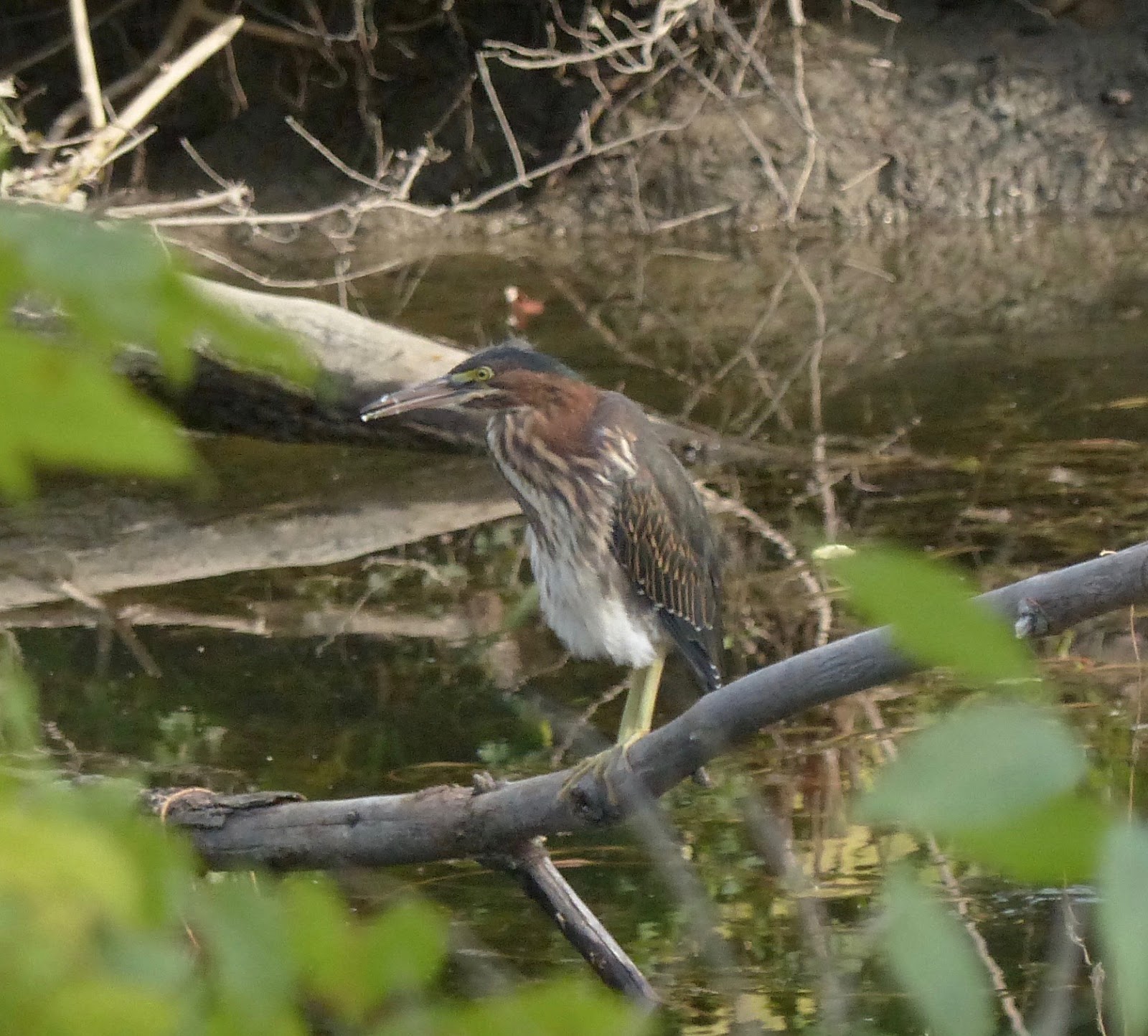
I parked in the small parking lot next to the tennis courts and the YMCA building.  About a minute later this Green Heron flew silently by just over the water and through the little tunnel under the road.    I walked across the road to the head of the woodland trail and there it was perched and preening. 


Above and below:  The Green Heron standing on both legs.  


A couple of times I thought it would flush, but overall it seemed unperturbed and continued preening or just standing on one leg.  I sat and the edge of the bank and took these photos.


Above and below:  Cannot tell with Sympetrum species but I'm guessing Ruby Meadowhawk (S. rubicundulum) - above male, below female.  Sympetrum sp. dragonflies are those that I first learned must be identified in the hand.  See addendum below.


Purple Fringed Orchid (Platanthera psycodes)


Belle Isle trail now has stands of cattails in the woods on the south side.


Female vs. 1st year Indigo Bunting (Passerina cyanea).


Above:  A very worn Eyed Brown (Satyrodes eurydice) vs. a Northern Pearly Eye (Enodia anthedon).  If it was a better photo and fresher butterfly it would be easier.


Least Skipper (Ancyloxypha numitor)


Above:   Did I see an Elfin Skimmer (Nannothemis bella)?  I should have been more attentive to this.  About 3/4 of an inch long, hovering mostly, landed once but I missed the shot, looked like a dragonfly but so small I couldn't quite believe it.  When I got home to do some more research ... regretfully, I think it may have been.  See addendum below.

I submitted another new, for me, dragonfly from this morning to Odonata Central for confirmation of ID.  When confirmed, I'll do a separate entry. 
   

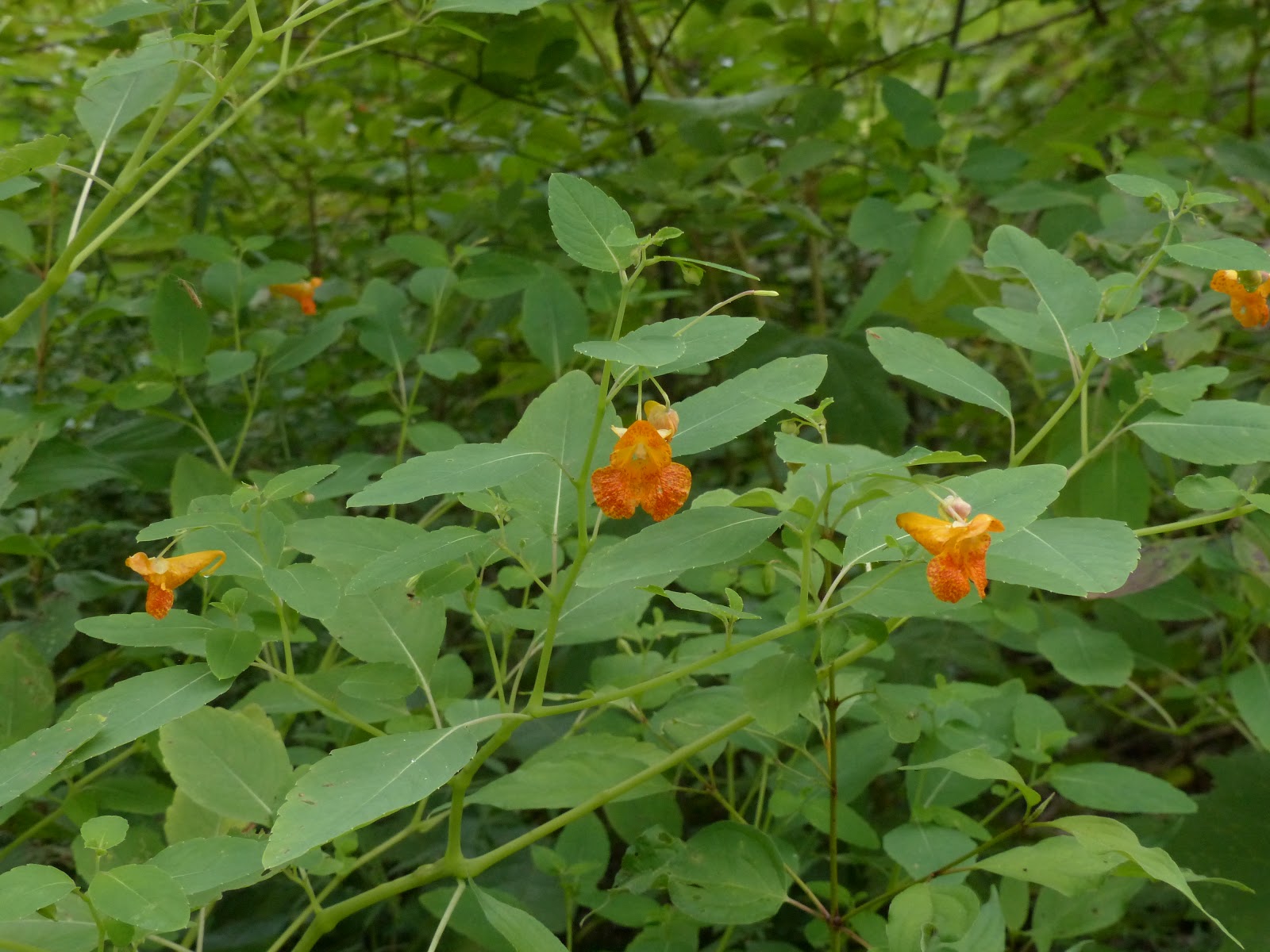
Spotted Touch-Me-Not (Impatiens capensis)


For comparison with Silvery Checkerspot from last Sunday, here Pearl Crescent (Phyciodes tharos).


Would you believe that over an hour and a half later, the young Green Heron was still perched in the same spot?  I saw a group of kayakers come down this stream and to do this they would have had to paddle right by this bird. 


I went to the east end of Lake Okonoka which had been so good for dragonflies earlier in the summer.  I did not see a single one, but I did flush this probably adult Green Heron to the opposite side of a small island for my last photo of the morning.

The crowds were large because of a boat race on the Detroit side and a run that was going on around the park.  The baseball diamonds are being improved and there were large mounds of dirt, along with earth moving machines parked on the diamonds.  Canada Geese were in large numbers on the baseball diamonds despite the disruption. In spite of all this, Belle Isle was beautiful this morning.

08/28/2017 addendum to the above - with assistance from Darrin O'Brien.

1.  The Meadowhawks appear to be a male White-faced and possibly a female Autumn, not confirmed but a guess at a likely ID based on abdominal markings and size.  Looking at the genitalia would be more diagnostic. Female Autumns are easy to ID in the field due to their scoop-type ovipositor.  Even under a microscope, the White-faced/Ruby/Cherry-faced species may not be determined due to the confusing overlap occurring in SE MI.


2.  The suspect insect is not an Elfin Skimmer. They are a species of bogs and we only found them in NW Wayne County near some now destroyed (due to subdivisions) wetlands near 5-Mile and Beck. They stop flying in early August.   The insect actually looks to be a fly of the Genus Ocyptamus.

Saturday, August 26, 2017

Butterflies

Last Sunday I joined Roger and another butterfly counter, Jeff, at Leonard Preserve in Manchester.  It has been years, it seems, that I last joined Roger on a NABA count and have become terribly out of practice with butterfly identification.  I restored a little of my skill last Sunday. It was hot and the pre-eclipse sun was very bright making it a challenge for photos.     


Silver-spotted Skipper (Epargyreus clarus


Eastern-tailed Blue (Cupido comyntas)


Common Ringlet (Coenonympha tullia)


American Copper (Lycaena phlaeas)


Above:  Of the genus Misumena, the flower crab spiders, this could be Goldenrod crab spider (Misumena vatia).  Unfortunately, my photo is horrible - as always when it's something new or special.  I love photographing orb weaver spiders, but  I can't recall ever having seen a crab spider of any kind.  It's one of the things that make this kind of outing so full of possibility.


Easter Tiger Swallowtail (Papilio glaucus) - fairly fresh with tails intact but with chunks out of left and right wings.


Leonard's Skipper (Hesperia leonardus) - a first for me.  We saw several around a hillside meadow covered with rough blazing star (Liatris aspera).  Roger commented that Leonard's skippers love purple flowers. 


Above and below:  Another new butterfly for me, Silvery Checkerspot (Chlosyne nycteis) - we saw several along a couple of wooded trails. The thing is, I may have seen this butterfly before but just dismissed it as another Pearl Crescent (Phyciodes tharos) of which we also saw several.  I'll know the difference next time and take a closer look.


I left the count at 1:00 pm, but Roger and Jeff soldiered on and may have found some other species.  One of Roger's targets was Common Roadside-skipper (Amblyscirtes vialis).  I don't know if they found one.