Sunday, June 22, 2025

Taking a break from Finland and Norway

I am going to assume that readers might enjoy a break from the Finland and Norway posts although, if I say so myself, the best is yet to come.  

I needed a break.  Yesterday I hauled myself on a three hour drive south to Urbana, Ohio to try to find Gray Petaltail (Tachopteryx thoreyi) at a really nice fen.  This was my second visit there - the first being mid-July last year - when I did not see the Gray Petaltail.  We hypothesized that mid-July was already too late to see them.  Going by Odonata of Ohio (pages 188-189), (incidentally, you can purchase this excellent book many places for much less than $65) June seems to be their month.  "Gray Petaltails are specialists of wooded seeps and often frequent quite shady haunts.  It sometimes occurs around the margins of fens, ponds or forested glades ..." (page 189). 

Cedar Bog features a mile long boardwalk through precisely this kind of habitat.  I stayed about three hours and circled the boardwalk twice.  I found a couple of other things but, when compared with my first visit last July, there were few Odonata.  Cedar Bog also hosts other speciality odes.  No Gray Petattails were found on this day. 

Here's what I saw and was happy to see them - only my second time ever, the first time also at Cedar Bog.


Female Elfin Skimmer (Nannothemis bella)


Male Elfin Skimmer


Elfin Skimmers are well named.  Elfin indeed.  They are so small - the female is possibly easier to see because of her color; but the male hides very well.  Last year I think my photos of the female Elfin were comparable to these.  My photos of the male Elfin this time are much better.  Both ♀︎ and ♂︎ are pretty jittery and, for me at least, this also makes for a difficult photo op. 

Pink Lady's Slipper (Cypripedium acaule)

This was overlooked - it was sort of hidden as you can see from my not great photo - until a park employee came by to point it out to us.  I think we were seeing the last bloom of the season.


Two Hackberry Emperor butterfliess (Asterocampa celtis) on fox scat accompanied by a red-eyed fly in photo below. 


Many years ago I had a common hackberry tree (Celtis occidentalis) planted in my front yard just to see if I could attract this butterfly.  No luck in my yard, but super happy to see several of them yesterday.  Even if it hasn't yet attracted the Hackberry Emperor, my Celtis occidentalis is the tree that attracts many birds in both spring and fall migrations.


Hackberry Emperor perched in shadow on a tree trunk.


About five Prince Baskettail's (Epitheca princeps) were hawking insects over a fen meadow.

Ebony Jewelwing (Calopteryx maculata)

Cedar Bog attracts a variety of human visitors.  There were families walking the boardwalk - no bins, no camera - just visiting and looking. It also attracts photographers and there were many present yesterday. I got acquainted with a couple and they helped me find things.  That's who the 'us' is in the Lady Slipper anecdote.

Cedar Bog is surprisingly uncrowded - but it was hot yesterday so it may not have been a representative Saturday.  For me, coming from SE Michigan, it's also a challenging drive.  About half the drive is on I-75 South and the other half is on two lane highways through pleasing small towns and farmland.  While the drive along the rural roads may be pretty, it's still challenging.  That might be a good thing.  Otherwise, I could be tempted to become a more frequent visitor.

Thursday, June 19, 2025

Two good loons and another bird

I will admit, up front, that this blog entry contains the worst photos of all.  Couldn't be helped.  Still May 30th.  Still coastal Norway.  At Syltefjord, and still looking at birds through a spotting scope.  The birds were distant, but at least they were floating.


Front bird - Silhouetted Red-throated Loon (Gavia stellata).
      

Above and two below: the photos get slightly better in the 2nd and 3rd spots.
Arctic Loon (Gavia arctica), for us Black-throated Loon


The Arctic Loon was a male in breeding plumage and an extremely attractive bird.  One of my favorites.


Above:  Use your imagination and it's possibly the best photo for a better sense of the bird.  The Arctic Loon is a stunning bird.  Would have been wonderful to see it closer.  Mostly a Siberian breeder and the couple of Arctic Loons we saw were in passage to Siberia.


What is this?  Another loon in passage to Siberia.


White-billed Loon (Gavia adamsii); our Yellow-billed Loon.

I think both Arctic Loon and White-billed Loon are better names for these birds.  I'm unlikely to ever see either again.  Very happy to see both in Norway.


(Eurasian) Oystercatcher (Haematopus ostralegus)

Noisy, always present bird which seems like we saw everywhere.  We saw it along the roadside our first night at the industrial park where we saw the Terek Sandpiper.  I saw it walking along rooftops, along old, broken down wharfs, nesting along a road in Båtsfjord Harbor and nesting on a man-made structure at a roadside rest area, along lakes and rocky shores.  Everywhere.  Of the many photos of Oystercatcher I tried for, this is really the only one I like.  I can see the red eye.


In flight across the harbor.  Everywhere.

The lighthouse

Our second stop on the morning of May 30th was Kjølnes Lighthouse in Norway.  It was gray, cold and windy.  From this point forward I am no longer going to write that it was windy.   In coastal Norway, it is windy - all the time.  Not just a mild, ocean breeze.  No, gusty, cold wind.  I had to face it; we were above the Arctic Circle.  We did get a lucky break from the wind, once, which I'll write about later.

Both of our guides had Swarovski spotting scopes and these served us well throughout the trip.  We received instructions on spotting scope etiquette at the start of the trip, but these were forgotten at the first opportunity.  I noticed also that many, including myself, were squeamish about moving or focusing the scope.  I felt like I couldn't touch the scope.  I'm not sure how valuable a sea watch is under such conditions.  Gray skies, gray water and wind.  If something good was seen by the guides, (one trip participant described it as, "looking at dots over the water") it meant that twelve people had to line up behind the scopes for their own look.  This also meant that the dot on or over the water was most often long gone by the time, say, the third or fourth in line got their turn.  I stuck with this as long as I could stand it.  It's my least favorite way to see birds (tied with looking through dirty van windows).  If it's a life bird I'll certainly give it a try, but I typically don't see the bird well enough to count it anyway.  This is true even for a trip bird.  We had three sea watches under these conditions - the very last one was probably the absolute worst.  In my view, in addition to wasting time, activities like this probably pad the trip species list more than anything else.  I know many will disagree.      

Fortunately this was also lunch time; on this day, bagged lunches.  I got my bag, made a cup of coffee and left the lighthouse to find a place to eat out of the wind.  I never returned.  

After lunch my wandering took me around to the other outbuildings and a landscape which was either rocky or grassy little hills.  Away from the lighthouse the wind was diminished and it was very pretty especially around the little hills.         

Common Ringed Plover (Charadrius hiaticula) - seen often on this trip.


Above and below:  Red-throated Pipit (Anthus cervinus).

Anttu said that we were also looking for a Rock Pipit here for one of the trip members who needed it as a life bird.  My solo wondering scared up a pipit - I could tell by the way it was acting and flying - but it never settled to get a real look.  I thought it was a Rock Pipit (A. petrosus).  When everyone finally came down from the lighthouse I told Anttu that there was a Rock Pipit flying around in the grassy hills.  "Oh, let's find it."  He played the Rock Pipit vocalization and the bird that revealed itself was a Red-throated Pipit.  I had never seen a Rock Pipit or a Red-throated Pipit so I was pleased with either.  But, I was told that Red-throated Pipit was "so much better" because they are harder to find.  True enough, both birds have a very slender range along the coastlines.  We did later see a Rock Pipit - just one - and we also saw Red-throated Pipit at least once again after this.  


Believe it or not, the photo above is a different photo than the first.


Out-of-focus!  I loved this photo and I missed.

Nothing was ever said about seeing Red-throated Pipit on this trip.  I feel about pipits like I feel about wagtails.  We don't have enough of them; for me, American Pipit (A. rubescens) is really the only one possible.  I've never seen Sprague's Pipit (A, spragueii) out west, despite seriously looking on a trip across Montana in June 2009.  The Red-throated Pipit's range in Alaska is a mere decimal point* when compared with the range of, say, the Gray-headed Chickadee* - oops, I mean Siberian Tit.

On the list of my five favorite trip birds, I tied Ortolan Bunting and Red-throated Pipit in the fifth spot.  Maybe Red-throated Pipit should have been all by itself.  So much second guessing.


Landscape along the road leaving the lighthouse.

Coastal Norway's landscapes are beautiful and quite dramatic. Enlarge this photo to see the reindeer in the lower center left.

Addendum 07/25/2025

* The July 2025 edition of the ABA Birding magazine (Vol 57, No 4, pages 30-45) published an article suggesting that Gray-headed Chickadees may be extirpated from North America - both Alaska and NW Canada.  They have not been seen since 2018.  It's a good and extensive article; it's a sad article.  Undoubtedly, the search will continue and, hopefully, Gray-headed Chickadees will be relocated.  After all its range is vast!  But, this also makes my statement above completely false.  When I wrote mere decimal point above, this article had not yet been published.  Instead, I was trying to make a birding-style joke about the disputed name Gray-headed Chickadee that I write about in my Siberian Tit post.  (The range of Red-throated Pipit is indeed a decimal point in NW Alaska.  That part is still true.)

I would post a link to the article, titled Lost on the Frontier by Brad Meiklejohn, but having already posted it elsewhere, I know that non-ABA members are unable to access it.  If interested, and I highly recommend it, you may be able to find it on the newsstand of your local bookstore, or at your local library.  There is a photo of Loggerhead Shrike on the cover.  Finally, you can always join the American Birding Association.  It's a good organization and its monthly magazine has gotten better.

The last birds to have disappeared from the US are Eskimo Curlew and Bachman's Warbler, both last seen in the early 1960s and both now believed to be extinct.  The last confirmed Eskimo Curlew sighting was in Galveston, Texas in 1961, and the last Bachman's Warbler sighting was of a singing male in I'on Swamp near Charleston, South Carolina in 1962.

The article mentions Aplomado Falcon (Falco femoralis) and Thick-billed Parrot (Rhynchopsitta pachyrhyncha) as analogs to the chickadees (page 44), but both are still present in good numbers in adjacent Mexico and it is conceivably possible for either to re-establish in the US.  In fact, Thick-billed Parrot had been given some help and seems to be hanging on as a breeder and Aplomado Falcon has also been occasionally seen.  


Wednesday, June 18, 2025

Tundra birds

We saw many tundra birds and many over and over.  We were in and out of the vans all day long.  Many of the birds we saw in the tundra landscape were birds not necessarily expected.  The photos below represent some of the expected.  
  

Long-tailed Skua (Jaeger) (Stercorarius longicaudus).  We saw this bird many times here and elsewhere.  We also saw Arctic Skua (Parasitic) (Stercorarius parasiticus) here.  


Long-tailed Duck (Clangula hyemalis). 

We saw many Long-tailed Ducks, often in larger numbers, and I was hoping to hear them as described by Barry Lopez in his book Arctic Dreams*.  He wrote: " ... the haunting sound of oldsquaw in the ice, ahaalik, ahaalik ... " (page 404).   I remember reading this and going immediately to Merlin to see if this sound was in that app.  It was, and accurately described by Barry Lopez.  In the van we briefly mentioned the duck's pejorative nickname oldsquaw and I offered the Eskimo origins for this name that I had learned when reading Arctic Dreams. However, I did also find on-line a Chicago Ornithological Society column titled Dan's Feathursday Feature: Oldsquaw? which offers a good and thorough, but different, explanation of the origin of oldsquaw, blaming it instead on white people rather than Arctic native people.  I don't know which is correct, but I do know that Barry Lopez's book was meticulously researched.  Arctic Dreams was also published at a time, 1986, when political correctness was just beginning to make its cultural appearance.  I highly recommend Arctic Dreams for the beauty of Lopez's (now deceased) writing, and for his description of how the Arctic really looked and was before climate change was being widely discussed and acknowledged; that is, there was still ice and all of the life that the ice once supported.     


Eurasian Teal (Anas crecca)


Above and below:  Willow Ptarmigan (Lagopus lagopus)


Temminck's Stint (Calidris temminckii)


Reindeer way out on the tundra.


Above and eight below:  Rock Ptarmigan (Lagopus muta) for a good look.


Whooper Swans (Cygnus Cygnus) were seen daily and there were five in this tundra location.  That's snow melt they're swimming in. 

Of note:  Even though it is a European bird, we saw only two Mute Swans (C. olor) on the whole trip.  While not tundra birds, just to also mention, curiously we did not see many House Sparrows (Passer domesticus) either, and we did not see even a single Starling (Sturnus vulgaris).  We weren't looking for Starlings, of course, but when they are around you can't miss them.


*Arctic Dreama, Copyright © 1986 Barry Holstun Lopez.  First Vintage Books Edition, October 2001.

Tuesday, June 17, 2025

Contentment

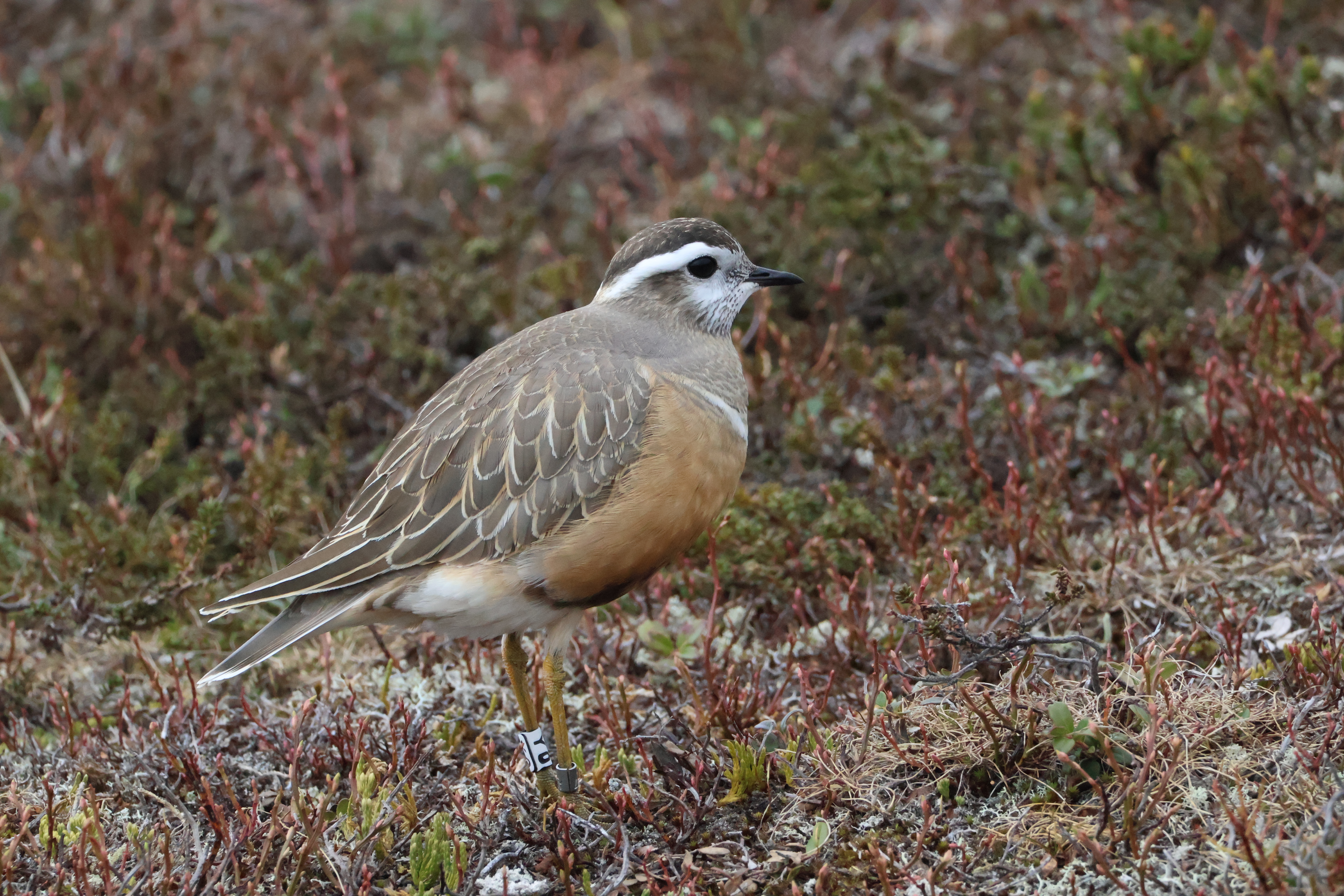
It was May 28th and we came here, to Inari--Saariselkä Kaunispää in Lapland, for one bird.  It was a bird everyone wanted to see.  Kaunispää (437 m) is one of the highest arctic hills near the Saariselkä village and the only one that can be reached by car.  We arrived at a large, tundra-like landscape and got out of the vans to begin our search.  It was cold, windy and raining.  We walked around for a while and then I heard one of our guys whistle.  He waved his arms.  "Hey you guys, we're being called."  I didn't know what he found, but I was closest to the spot he was calling from and I took off.  I slowed down as I got closer.  It was too windy and rainy to shout over. Suddenly, I saw what it was. The Eurasian Dotteral (Eudromias morinellus).  Moss had stepped very near the nest and the bird popped up leaving three eggs exposed. He took a photo of the eggs.  


This is how I first saw the bird.  I can't remember but I think the bird did vocalize.  He - it is a male bird - continued to distract those of us tromping over the tundra.  He was very close.  It had been banded by the Finnature group and it was the same bird that has been showing up here for at least a couple of years.  


We were starting to leave and I turned around to take a last look.

Back on the nest!

I can't remember if it was Nigel or Anttu but one, or both of them, took turns explaining this bird's breeding strategy.  The female bird is somewhat more brightly colored.

The Eurasian Dotterel exhibits a polygynandrous breeding strategy, specifically with serial polyandry.   Female Eurasian Dotterels arrive at breeding grounds and establish mating territories, competing with other females for access to males. Females are polyandrous, mating with multiple males, while males typically incubate the eggs and care for the young. This means the female lays multiple clutches, usually of three eggs, with different males and the male is left to raise the chicks from his clutch.  Our bird was sitting on his three eggs.  

There are many on-line sites where photos of the Eurasian Dotteral and its mating strategies are discussed.  I'm not a Birds of the World subscriber, but for those who are it's probably a satisfying deep dive.  eBird also has a good write-up with a good range map.  There are many others.

A scientific paper (1983) by two Norwegian researchers, Breeding Chronology and Mating System of the Eurasian Dotteral (Charadrius morinellus) was published in The Auk, and is available for free from The Digital Commons at the University of South Florida.  Of note:  the Dotterel's genus was relatively recently changed from Charadruis to Eudromias. 

True enough, the paper above is old, but it's also free.  It suggests that the female Dotterel may remain in the same area and breed with another male.  However, both Nigel and Anttu suggested that the departed female Dotterels can travel quite far to their next breeding sites.  The male will stay behind to incubate and take care of his offspring.  I am guilty of anthropomorphism, not always but occasionally, especially when it's something that really appeals to me. This was one of those things.  One of the other trip members was a wildlife biologist who had done a lot of work with birds, although ornithology was not her area of expertise.  We often sat together in the rear seat of the van.  I admitted to my anthropomorphism and commented how content the male Dotterel appeared on his nest. Contentment is a human emotion.  But, she agreed with me and went further with other examples of how research is opening doors where we are beginning to understand anthropomorphism differently. Specifically about our Dotterel - incubating his eggs is his whole goal in life.  It is well understood that birds have hard lives.  This bird had flown thousands of miles precisely to do what he was doing on the day we saw him.  He deserved some contentment which, in his case, is being a successful breeder.  I was worried that every birder in Finland would make a visit to see the Dotterel and his nest would fail.  But Anttu disagreed saying this Dotterel had been a successful breeder for the past couple of years. Finnature will, apparently, monitor this. Anttu may take part in this monitoring.  I worried less.

In the 2nd edition of Birds of Europe, the author wrote this about the male Dotterel:  "Nest is a bare scrape.  Male does most of incubation and care of young.  Some males are extremely tame just before eggs hatch" (page 142).  It's the last sentence that caught my attention.  

On the list of my five favorite birds I put the Eurasian Dotterel in my number two spot.  My number one bird is still coming up.  But, after looking at my photos again and writing this blog entry, I wish I had made the Dotterel my number one.  On any trip there always seems to be one bird that I become attached to.  On this trip it was this bird.

Addendum on 07/08/2025

Yesterday I emailed Anttu Topp (our Finnature guide) to inquire about the success of the Dotterel.  This morning I received Anttu's reply as follows and he further clarifies some of the information above:

1. I think it was successful because the male was still hatching in mid June when the last Finnature group visited the site. Hatching time can be 28 days so I don't know absolutely sure what was the result, but it has been successfully on the eggs already for about 20 days so it looks really promising. Of course the chicks have to survive many days before they can fly and I haven't heard anything about the chicks. Male was ringed on 07 Jul 2019 very close to where the nest was also this year.  It was only a few days old and it was still in the nest.

2. Yes you can use my photo.


Anttu's photo colors are richer and the bird's face and feather markings are much clearer.

Anttu writes that the Dotterel was ringed (banded) on 07 July 2019 from his nest when he was only a few days old, making him now six years old.  So, older than I originally thought and he has shown remarkable nest site fidelity.  The miles he has flown!