Sunday, February 9, 2014

The highlands and the Resplendent Quetzal


I have always thought of the Resplendent Quetzal (Pharomachrus mocinno) as being a deep forest bird.  Well, it is too, but for my life quetzal we walked to farm land at an elevation of approximately 10,000 meters.  This was one of my favorite mornings of the trip.  It was cool and overcast, perfect for a walk of about a mile along the Los Robles trail.  The habitat was varied and birdy.  Our guide, Vernon, wanted to find the quetzals here so as to avoid the crush of birders who would be looking for them around the Savegre River Lodge, our stop for the next two nights.  We stopped at the Paraiso Lodge to pick up Jorge who knew where the birds were.  Earlier in the day, a National Geographic filming crew had found many feeding in an avocado tree.


The above photo of the quetzal was bluish on my original photo.  Using my somewhat rudimentary iPhoto editing tools, I doctored the photo above to improve the green and red of the bird, although the bluish tinge is still seen.  


The photo above of the essentially hidden bird is completely unedited. Looking through the leaves one can see the quetzal's much truer colors. A female quetzal was also in this same tree, but she was much more hidden and my photos are not really worth sharing.


The quetzal's were feeding in an avocado tree growing in a cow pasture. These sweet cows were unperturbed by the presence of ten birders tromping through their field. 


Another spectacular bird was a pair of Long-tailed Silky Flycatchers (Ptilogonys caudatus).  The female above and male below were completely cooperative in terrific light.  I got many photos.  Hard to tell which was better than the next, so I just randomly selected these two.


A Black-billed Nighingale-Thrush (Catharus gracilirostris) popped out in front of us as we made our way back down the trail.


Jorge, in blue shirt, and Vernon in khakis.


Not too far along from where the photo of the strolling Jorge and Vernon was taken, Vernon spotted a bird on a utility wire over the path and called out excitedly, Ochraceous Pewee (Contopus ochraceus), a highly-sought and not too easily seen bird of the highlands.  Perched calmly and quietly on the utility wire, this bird didn't seem too special so I was happy to have Vernon's explanation.   


On the same utility wire, the Tufted Flycather (Mitrephanes phaeocercus) was more more active flycatching from a variety of perches.  In this photo, a hint of the bird's crest is seen.


In the photo above, the Tufted Fycatcher's bright ochre breast is much better seen.


The Costa Rican species of Hairy Woodpecker (Picoides villosus) above is smaller and darker than the North American race.


A home and farmstead photo taken from above on the trail.


The Paraiso restaurant and lodge where we had lunch.


From the backdoor of the restaurant was a deck where several hummingbird feeders were active.  Above, a Green Violet-ear (Colibri thalassinus) is nicely perched on the fence surrounding the deck.  A quick word about hummingbirds with this first hummingbird photo. The field guide, The Birds of Costa Rica by Richard Garrigues and Robert Dean, copyright 2007, names 52 species of hummingbirds on 20 pages, of which we saw 27 during our trip.  However, my camera is not ideal for taking photos of hummers unless, as above, they're quietly perched.  Matt Hysell, on the other hand, had great success with hummingbird photos, and will give significant attention to them on his blog, Birding Berrien and Beyond found in my blog list at right.    


The Paraiso Lodge dining room where we had an amazing lunch.


This back end photo of an overall very cooperative Sooty-capped Bush-Tanager (Chlorospingus pileatus) was all I could manage.  Throughout the trip, I would miss several photo ops just by being a putz with my camera.  On the other hand, this is also one of the limitations of using a point-and-shoot style camera.  It is never going to be as fast or as responsive as a SLR digital camera.     


Magnificent Hummingbird (Eugenes fulgens) - as you see, nicely perched.


Throughout the trip I took many dog photos.  But, of course.


A nice graphic map of the area.


Obstructed shot of the Mountain Elaenia (Elaenia frantzii).  Why bother, right?  Halfway through day number one we move on to Savegne River Lodge.

To be continued ...


Saturday, February 8, 2014

Hotel Bougainvillea, Costa Rica


Good fortune and a love of birding took me to Costa Rica for a full week at the end of January.  A group of eight birders assembled for the trip arrived in San Jose, Costa Rica on the 28th for our first night at the Bougainvillea Hotel and, after check-in, it  didn't take longer than fifteen minutes to get out to bird the fantastic ten acre gardens of this beautiful hotel. 


Tropical Kingbirds (Tyrannus melancholics) were present on each day of the trip in all locations and habitats.  This was my first and best photo of those I took of TK.  I used a new Panasonic Lumix FZ200 camera for all photos taken this trip.  Immediately obvious was the excellent light conditions for taking photographs on this first day.


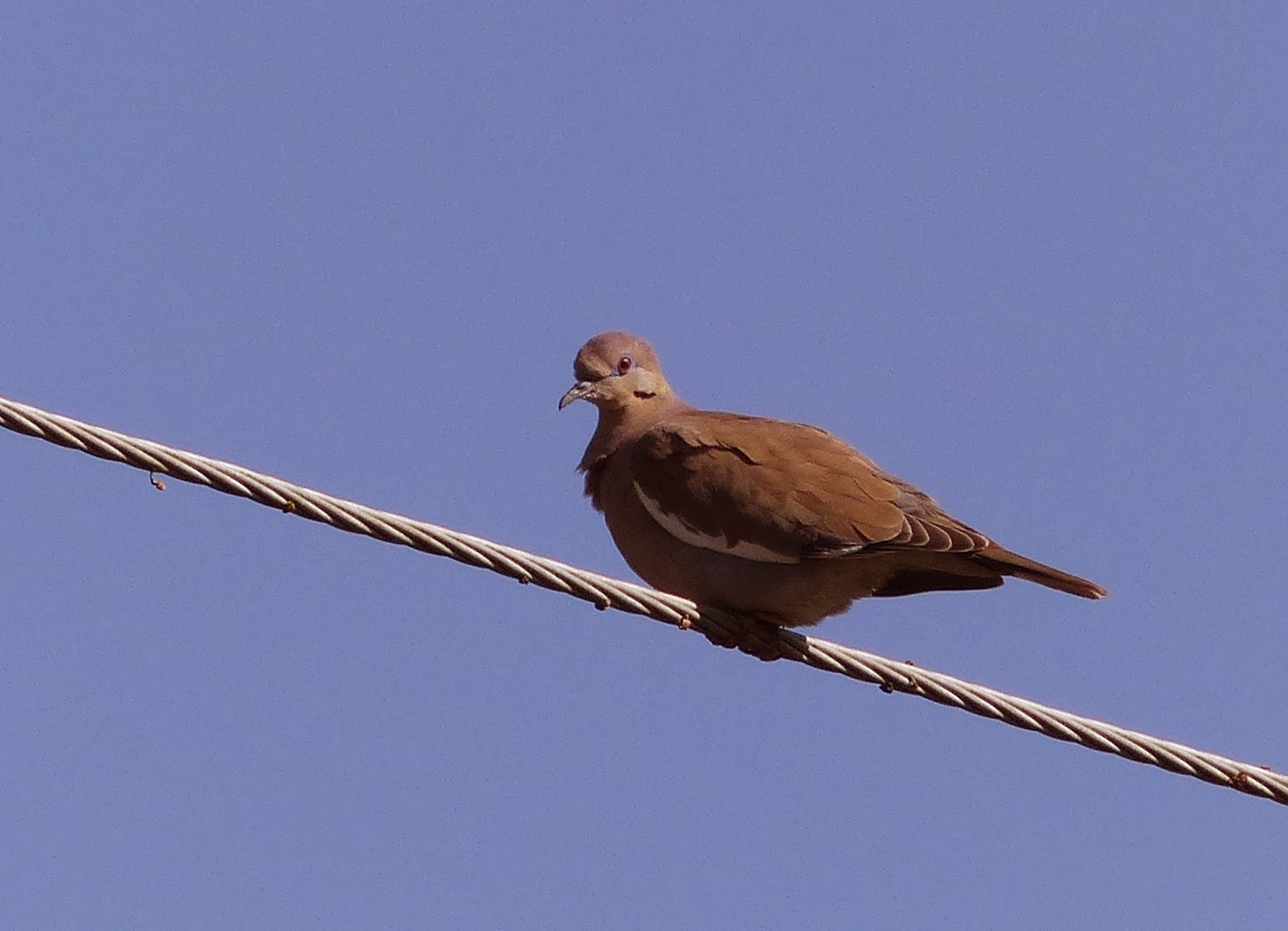
White-winged Dove (Zenaida asiatica) - not too special, but a very pretty dove nevertheless.


The only other time I have seen Red-billed Pigeon (Patagioenas flavirostris) were Rio Grand River fly overs in south Texas, so it was quite nice to see this large, quite spectacular pigeon nicely perched.


Don't know which it is yet, but I thought this was a pretty little butterfly.


This Wood Thrush (Hylocichla mustelina) popped out in the open just long enough for me to get this nice photo.  Fun to see our summer visitor on its wintering grounds.  


We saw, but mostly heard, Rufous-naped Wren (Campylorhynchus rufinucha) many times throughout the trip, but this little beauty posed in the Beaugainvillea gardens and was my first life bird thriller. 


A Grayish Saltator (Saltator coerulescens) perched quietly relatively high in a tree in the sunny late afternoon.


Hoffmann's Woodpeckers (Melanerpes hoffmannii) were present as a pair, but this male in the nest cavity was in the best light for a photo. The gold feathers on his nape can just be glimpsed in the bright sun.


Rufous-collared Sparrow (Zonotrichia capensis) is one of the most recognized birds in Central and South America.  Good little singer, too. We saw and heard many.


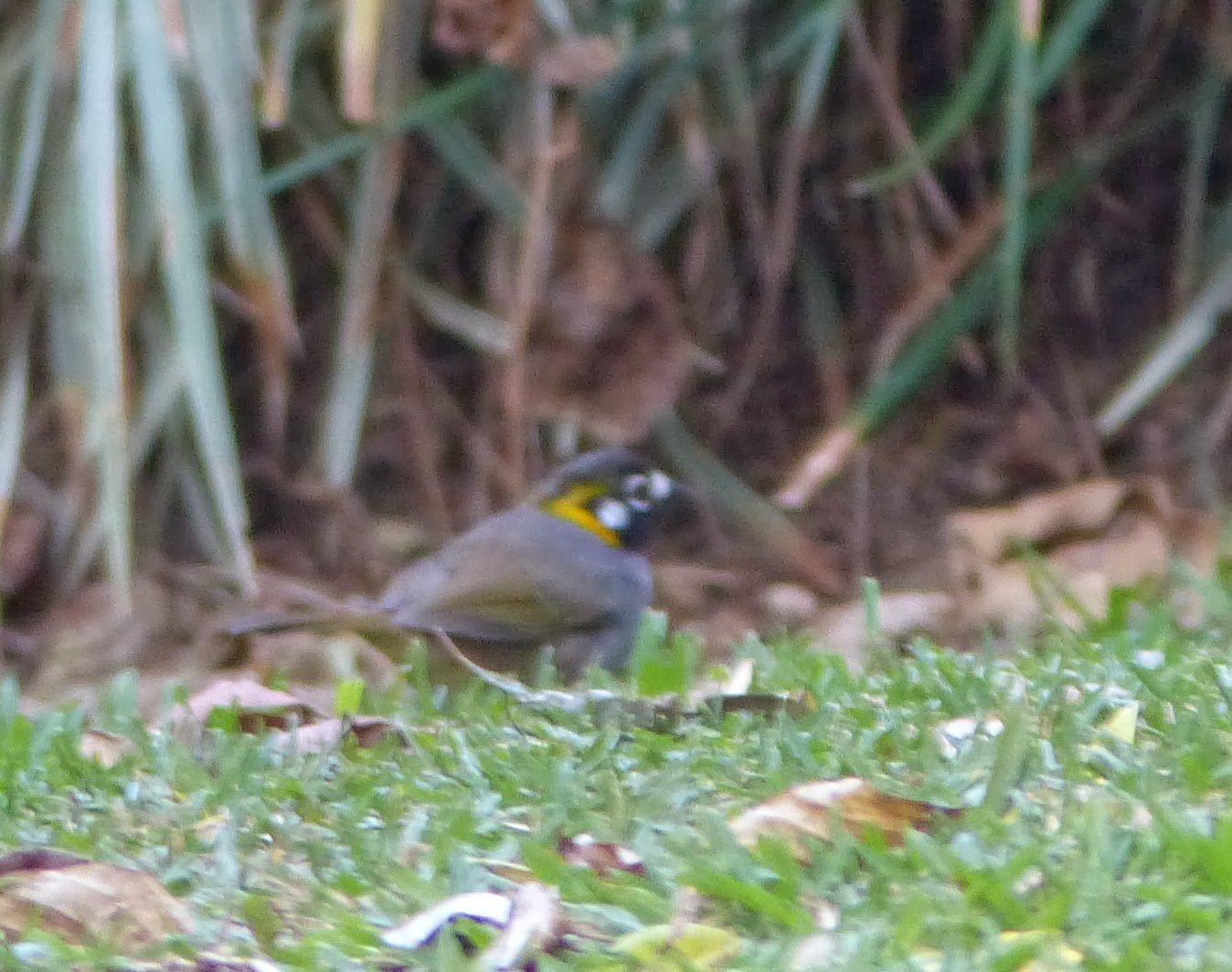
Matt Hysell found this White-eared Ground-Sparrow (Melozone leucotis) late in the afternoon in a sunless little corner of the garden.  It is a completely beautiful and unique little bird.  Unfortunately, this is the best I could do for a photo.  This is the one and only that we found for the trip.  I would have liked to see it again.  For a much better photo of this bird, see Matt Hysell's blog, Birding Berrien and Beyond.  Matt will also be blogging this trip and the link to his blog can be found in my blog list to the right.  


The next morning we met up with our field guide for the trip, Vernon Campos, and together birded the gardens before breakfast.  We saw Blue-crowned Motmot (Momotus momota) the evening before and I got photos that thrilled me, but my photos from this morning walk were even better. 


Breathtaking!


I guess I have seen banana trees in photos, but I have actually never seen how bananas grow.  This is a banana clump with an unbloomed banana flower at the bottom.    


This photo of San Jose stretched out in the valley was taken from our balcony on the first evening.


A view of the gardens from the balcony.


The hotel's front gardens in spectacular sunshine as we departed for our next stop.

To be continued ... next ... to the Highlands.


Saturday, January 18, 2014

Stop killing Snowy Owls at the Gerald R. Ford International Airport in Grand Rapids, Michigan

PETITION IS NOW CLOSED - thanks to all who signed.

Hi!

I just signed the petition "Gerald R. Ford International Airport: Stop Killing Snowy Owls" on Change.org.

It's important. Will you sign it too? Here's the link:

http://www.change.org/petitions/gerald-r-ford-international-airport-stop-killing-snowy-owls?share_id=rYDqJCXpWu&utm_campaign=signature_receipt&utm_medium=email&utm_source=share_petition

Thanks!

Cathy

Wednesday, January 1, 2014

Starting 2014 - Detroit River CBC

Counting for the Detroit River Christmas bird count this morning got me off on the right foot with a few photos to start the year.   24 species on a day of continuous heavy snow and wind chill was a great way to get the year started.  I had to figure out how to get up and down some inclines and fell twice.  Nevertheless, it turned out to be a great day.  

eBird check list here.


Sunday, November 10, 2013

Illustrating and journaling our natural world

Artemis Eyster speaks about and demonstrates journaling in our natural world.  This is worth watching more than once.  Over the past many years, I have come to appreciate Artemis as one of our most talented and skillful botanical illustrators.