Saturday, June 28, 2014

Hungary: Things I saw enroute to ...

... seeing Black Woodpecker.  

Moving on in Hungary and leaving the region of the Kunsagi Nemzeti Park, we again travelled and stopped along our route.


In English, the sign reads "Duck Nature Trail," it guides you through the rich wildlife of wetlands and of the surrounding grasslands, the so called puszta.


The marsh was subtly beautiful.  We climbed a not very tall observation platform which nevertheless gave us a panoramic view.

Gerard noticed first the pellet of an owl of some sort; but he found more interesting the small pile of sawdust coming from a carpenter bee hole in the observation tower support post.  He is currently writing a book on "signs and tracks" and he took several photos to submit to his publisher.  


There were many [Northern] Lapwings (Vanellus vanellus) in this marsh.  Typically they remain hidden in the tall grass until something presents itself that make them become visible and vocal.  Gerard commented that lapwings will go after everything and anything.


As if on cue, a red fox began to run across the marsh being chased and berated by lapwings as can be seen in the photos above and below.


Still running and still hotly pursued by lapwings.


The lapwings have done their job and the fox moves on free of their harassment.  I've always liked foxes and on this trip I came to like them all the more.


In this park, water buffalo have been introduced for marsh grass maintenance because they will eat anything.   Research is abundant on grazing animals in grasslands related to the quality and the intensity of the grazing and which is and is not beneficial for grassland health. 


Moving on to another roadside marsh, we found Black-tailed Godwit (Limosa limosa) and Eurasian Curlew (Numenius arquata), below. Our Whimbrel, Bristle-thighed and Long-billed curlews are also in the Numenius family.  


For some reason, I did not expect to see [Northern] Wheatear (Oenanthe oenanthe) in Hungary.  But in summer they are widespread throughout the continent.


The Cardinal Fritillary (Argynnis pandora) is as spectacular in flight as it is perched.  In flight it is easily recognized as a fritillary but is different from our Speyeria and Boloria fritillary families.  This is evident by the Argynnis species different wing shape and different, darker color.  The Cardinal fritillary is widespread throughout Europe and, in Hungary, I saw it often.  I love the green underwing of this butterfly.  The upper wing is equally dramatic.  There are 48 species of fritillary in Europe, and another, found in my final days, I just cannot identify.


I have been through every fritillary in the Collins Butterfly Guide several times and without it's upper wing fully open, I cannot settle on this butterfly's identification.  Unfortunately, they just don't land that way and it's a lopsided photo anyway.

Butterflying (is this a word?) is as popular in Europe, especially among the Brits, as it is here.  Later we also saw a Southern Festoon (Zerynthia polyxena) which is highly sought after by British butterfliers.


Southern Festoon

Thursday, June 26, 2014

Cats Belong Indoors

Today a neighbor sent me an email titled "Pets" with several dog and cat links.  Each link highlighted the antics of dogs and cats and how these are very different.  Cute.  You know, one of those emails that you may, or may not open, view and then quickly delete.

However, one of the links in particular stuck in my craw - (I like this idiom for this because "craw" is the throat of a bird.  When the something cannot be dislodged it is truly annoying.)

Cats relationship with birds

And, here is my email reply: "The only one I didn't like was the cat catching the bird.  Cats are one of the greatest threats to our wild bird population.  What was happening in that video was that the cat was watching that bird's nest with young and the adult/parent bird was trying to distract it.  Cats kill millions of wild birds annually.  One day when we wake up without bird song (hopefully not in your lifetime or mine) outdoor cats will have played a significant role.  This, in a nutshell, is why my cats are indoor cats. 


He looks like he could take out a few birds ...


... but, of the two, she's the skillful hunter!

Otherwise, it was cute.  Thanks for sending."  

For comparison, here is the video Dogs relationship with birds.   Incidentally, I think the bird in the cat video was a mockingbird - one of our great songsters.

I'm deleting the email now.

Sunday, June 22, 2014

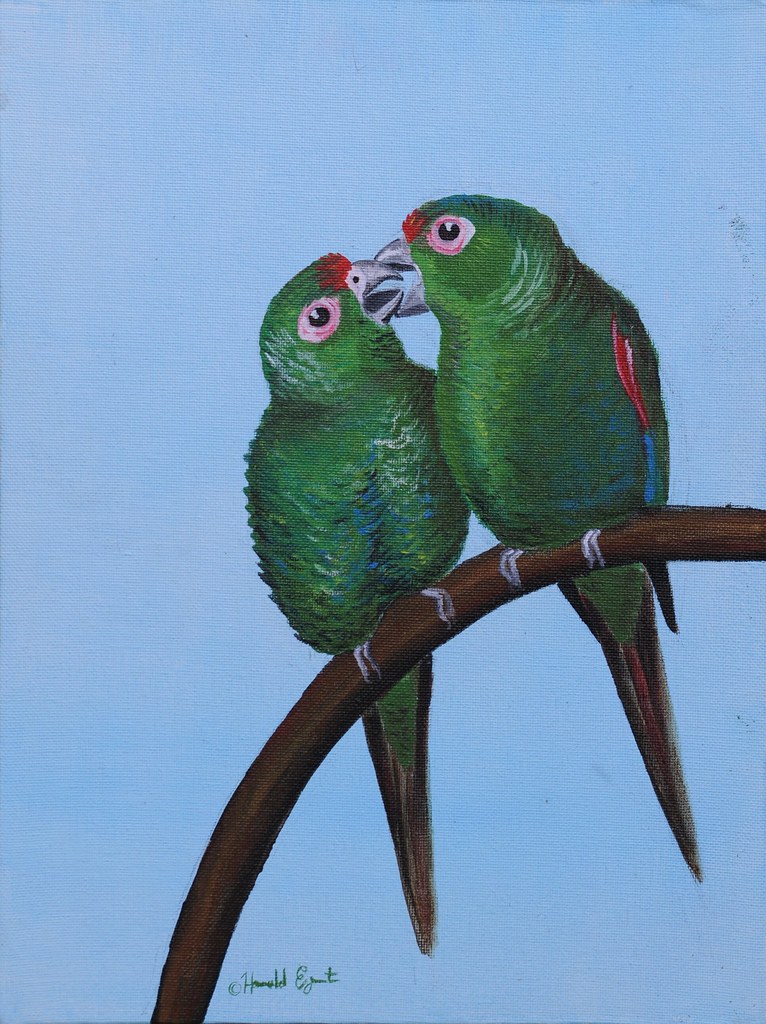
Harold Eyster: Painting birds in Ecuador and more

Again, taking a brief but important diversion from my trip to Hungary, this morning I received a much needed gift in the form of an email from Harold Eyster.

Harold is currently traveling in Ecuador and while I am sure he will do many things during this trip, one of the things I know he is doing for sure is painting birds.  Harold's email gift included his Flickr Photostream with the first eighteen images being of birds he has painted thus far.  For a real treat and opportunity to appreciate true talent, please check out Harold's link.  You won't be disappointed.  

Many of his other drawings, paintings and travel photos are also included in this link.  For example, I see from the 7th image that Harold was able to see a Fork-tailed Flycatcher last month in the famous for birding Mt. Auburn Cemetery in Cambridge, Massachusetts.

As have many, I first met Harold and his sister, Artemis, when they were 7 and 5 years old respectively.  I don't know how I ever got so lucky to have my path cross theirs, but the benefit and pleasure has been all mine.

El Oro Parakeet (Pyrrhura orcesi) by Harold Eyser, June 2014


Friday, June 20, 2014

Eastern Pond Turtle

Still in Hungary but diverting from birds for this post.

As I mentioned in my Red-footed Falcon entry, one of the perks of taking a one-to-one birding trip were stops like this.

Those who know me know that as a young child turtles were my first pets.  Back when they were plentiful, we caught them and brought them home from the lake to swim in circles in a large oval, enamel tub. When they tired of their endless swimming, they could climb up and rest on a rock placed in the center of the tub.  We, my brothers and sisters and I, fed our turtles raw hamburger which my mother would pluck from the pound she had purchased for our dinner to form little round balls wrapped with wax paper and store in the freezer. Our turtles went after the raw hamburger voraciously.  At the end of the summer my parents would talk us into returning the turtles to the lake, which we did, sadly.  The turtles would rapidly swim away with no looks back.  This taught me an important lesson - wild things are wild.

So, I would say that I have a keen eye for spotting turtles crossing the road.  This is what happened with this guy ... "Gerard, it's a turtle, let's stop and get it across."  Fortunately, he agreed.


We got this guy safely across the road and, after several photos, let him make his own way forward.  I was having trouble seeing where he would go ... but, wherever this was, it was certainly better than swimming in circles around an oval tub being fed raw hamburger.

Thursday, June 19, 2014

Sandhill Crane Reunion

Taking a break from Hungary for a moment ...

I went to the Washtenaw Audubon Society meeting last evening for a terrific presentation of The Flora and Fauna of Florida by Don Chalfant.  Each WAS meeting begins with the question:  "What has everyone been seeing ...?"

This really nice story of Sandhill Crane Reunion came up during that discussion and I have linked the video documenting the journey. Sherry Smith and Lathe Claflin played a pivotal role in this reunion and both were present at the meeting last night and spoke about how this happened.  Lathe commented that this whole process took 1-1/2 hours to arrange via email and how amazing that was.  I agree.

The Washtenaw Audubon Society is a truly well-connected group of can-do birders who make things like this happen.

I highly recommend watching this 6 minute video.  It does the heart good.  Have your volume turned up.