Saturday, February 17, 2018

12,000 to 15,000 feet up

The first couple days of our trip were spent at elevation - around 12,000 feet to 15,000 feet - mostly birding along roads and from the van.  Fortunately, the windows of the van easily opened for some decent photos.  

I've been trying to think of the story that will go with my Ecuador birding posts, and unfortunately for me (not necessarily for you) there is little narrative to go with these photos.  Unfortunately for me only because I like the story and the writing of it.  This should not imply that the trip was not great - because it was - only that the way it unfolded was straightforward and uncomplicated.  There was no definitive Super Bowl of birding day, so to speak, but there were several fine and favorite moments.  I also made some observations about birding in a country with a well-established birding culture and infrastructure. Going forward most of my narrative will likely be comments on my observations. 

In no particular order, the following photos were taken enroute to and in and around Antisana National Park.


Brown-backed Chat-Tyrant (Ochthoeca fumicolor)


Terrible photo of White-crested Elaenia (Elaenia albiceps)


Plain-colored Seedeater (Catemenia inornata)


Great Thrush (Turdus fuscater) - seen and heard everyday


Black-winged Ground-Dove (Metriopelia melanoptera)


Above and below:  female Ecuadorian Hillstar (Oreotrochilus chimborazo)


View of Ecuadorian Hillstar landscape.


Above and below:  Stout-billed Cinclodes (Cinclodes excelsior)


Andean Lapwing (Vanellus resplendens)


Carunculated Caracara (Phalcoboenus carunculatus)


Tawny Antpitta (Grallaria quitensis)


Chestnut-winged Cinclodes (Cinclodes albidiventris)


Many-striped Canastero (Asthenes flammulata)


Horrible photo of Aplomado Falcon (Falco femoralis) - but nice to see.
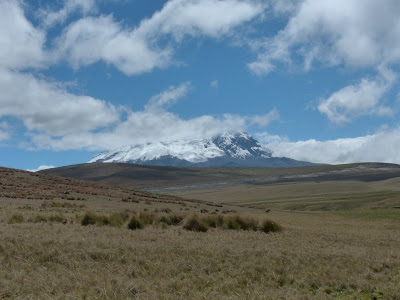

Antisana Volcano (above) looms over the Artisana NP and was seen from all of our high-elevation birding locations.  Whenever I saw this volcano I couldn't resist yet another photo.

The photos above were taken around an elevation of 12,000 - 13,000 feet.  The landscape was stark, wide-open and very beautiful.  It was essentially a high-elevation desert.  The birds seen here were so different than any seen elsewhere in Ecuador and even very different than any North American birds. 

My next post will be from 15,000 feet where we went twice to look unsuccessfully for Rufous-bellied Seedsnipe (Attagis gayi latreillii) and Giant Conebill (Oreomanes fraseri).   

Saturday, February 10, 2018

Return from Ecuador

Unrestrained by snow, snow, snow and more snow, I returned from Eduador less than 24 hours ago.  Going through just under 2,000 photos now - still in the deleting phase - and will be making some posts soon.

Have some running around to do, but more soon.  In the meantime, Dorian Anderson has also recently completed a trip to Ecuador and is writing about it on his blog The Speckled Hatchback.  His  post #129 includes many of the places we visited in the Tandayapa valley, including maps, which I am terrible at trying to do.

For now some photos of a charming little bird we all know and love for which it will be unlikely to find a place for elsewhere.


The photos above and many others were taken at Puembo Birding Garden.  The Puembo Birding Garden has a big on-line presence which I recommend checking out.

Saturday, January 20, 2018

Eagle Optics closed

Recently a query for recommendations about binocular selection posted to a list serve I read caught my attention.  In this same query there was mention that Eagle Optics had closed.  Eagle Optics closed?

Turns out to be true.  This was a stunner.  To me Eagle Optics was always the premier birding optics resource with a retail store in Wisconsin (I had never been) and an excellent on-line presence.  Their telephone support was superlative.   If you go to the Eagle Optics website you will read the following:

"After over 30 years as a successful sport optics retailer, it became even more challenging to run a specialized business, and on 12/31/17, Eagle Optics is ceasing all business operations.

As always, Eagle Optics recognizes that without our customers and partners, we could not have been successful in our support of the birding community and bird conservation. We want to thank you and are eternally grateful for the relationships, partnerships, and community we have built together."

It says a lot about the support Eagle Optics provided over the period of time when birding exploded in popularity.  It says a lot that this kind of specialty business can no longer be successful in our current purchasing/retail/commercial landscape.


Just before this past Christmas, I spent a great afternoon with book-loving reading friends.  Their house is loaded with books.  It's so interesting and fun to stand in front of one of their bookshelves and scan over the titles.  My friends live in a university city with a great independent bookstore owned by a young couple.  The store is very successful and my friends mean to do their part to keep it that way. They no longer purchase from Amazon or other on-line sites.

In full disclosure, I do purchase books from Amazon, but my friends have got me thinking.  This afternoon, I'm off to the Barnes and Noble store 3 miles from my house to see if they are carrying a book I want to purchase.  Remember when "big box stores" were the threat?  I recently re-watched the 1998 romantic comedy "You've Got Mail"  and thought it was even better 20 years later.  If the "big box" Barnes and Noble near my house were to close, there would be no bookstore around for miles and miles - not a good thing in a country with illiteracy rising at an alarming rate.

If only the same had been so for birders support for Eagle Optics.  I'm grateful for the spotting scope and tripod purchase I made from Eagle Optics and will always think fondly of my experiences with their business.  They served us well.

So where do we go for binocular information now?  For now at least, there are still on-line binocular reviews of the Eagle Optics Ranger line. One  such review by Optics Reviewer also offered a short history of how Eagle Optics came to be.  Cornell Lab of Ornithology also offers occasional reviews as does Birders journal.

Sunday, December 31, 2017

Year end book review: Birding Without Borders

Even though I should have got this review out well before Christmas, I managed to get it written just in time for the New Year.


In 2015 Noah Strycker took his, by now, well-known trip around the world with the goal of seeing 5,000 birds and thereby breaking the previous record.  By the end of 2015, he had been more than successful in achieving his goal.  Birding Without Borders is the documentation of his year


Throughout 2015 I followed Noah's travels via his daily blog entries sponsored by the National Audubon Society so I already knew the story and the outcome.  I did wonder how he would consolidate a whole year of constant movement through 42 countries with over 6,000 bird sightings into a book.  The answer is that he doesn't.  He selected and wrote about his highlights.

What was most interesting to me was the planning he put into his trip and the rationale he gives for the decisions he made.  For example, he connected with local birders in each country - some relatively well-known like Gunnar Engblom in Peru and others completely unknown. Noah called it his grass roots strategy.  The success of this strategy seems to have surprised even him.  


Despite what one imagines could have happened when traveling alone to unknown countries, remarkably Noah seems to have run into relatively little trouble.  He writes about one such negative experience, in Cameroon, where the only birder he could find in the country was Benji who had spent all of the money Noah had wired ahead to him (for transportation, making reservations, etc.) on his personal debts.  He still needed to get through his time in Cameroon so Noah had to give Benji yet more money which he never did pay back.  If this was not bad enough, he arrived in Cameroon during the rainy season and birded the whole time in rain and mud.  Starting on page 187. in one long paragraph, he describes his Cameroon birding experience with ample detail to get the gist of his time in that country. Just brief mention of days without a shower and, in the morning, putting on the same wet and muddy clothes reveals the less glamorous side of his experience.  I think he actually boarded planes wearing wet and muddy clothes.  Not all birding is fun.
    

Something significant and, for me, most enjoyable about Noah Strycker's writing, is his connected, yet unconnected, commentary writing.  If someone is curious about birding, what it is and why people do it, Birding Without Borders goes a long way to address that curiosity.  He also writes about characteristics of the culture of some countries he visited - like the dangers of driving in Peru or India's obsession with breaking records.

While Noah's fine writing is evident throughout his book, surprisingly writing about his bird sightings was where finding his words seemed most difficult.  There seemed to be a lot of "wows" and "amazings" that left me thinking there might be better words to describe the experiences.  Overall, such banal descriptions were insignificant.  As Noah approaches the end of the year, he writes about time in a way that is very insightful. He pulls things together beautifully in his final chapter, From End to End.  You can read a part of this by enlarging the photo above.

It seems that Noah selected to do this trip at the perfect time for him. He was just under 30 years old (I think), a knowledgable and compulsive birder, already an experienced traveller, a published author and not yet truly committed to anything else in life. His book is published and we now know that Noah's record was smashed the following year by a young Dutch birder. Noah alludes to this in Birding Without Borders. Yet, for me, it remains clear that Noah's record, even broken, was the more significant of the two.  I tried to follow the young Dutch birder's 2016 progress but found his communication sites inaccessible and unclear and eventually gave up.

I recommend Birding without Borders for both deep and shallow reading.  While following Noah's trip on his blog and again while reading his book, I found myself returning over and over to a single question.  Could a woman do this kind of trip with the goal of breaking the record?  While a part of me would like to see a woman take up this challenge, it comes with grave concern for the risks to her safety that such an endeavor would surely be fraught with.  I imagine there will be other men who try to break the record - to many, this is what birding is all about - but this now seems entirely unnecessary.  For both humans and birds alike the world has changed so much between 2015 to 2018.

In anticipation of reading Birding Without Borders, I also read and reviewed Noel's The Thing with Feathers on 09/14/2017.  You can read this review here.
       

Saturday, December 23, 2017

Just in time for Christmas - Bird Song Opera

Merry Christmas and Happy New Year in 2018 for much excitement in birding.

BIRD SONG OPERA